


APR vs Interest Rate: 7 Crucial Differences You Should Know
When you're comparing a credit card, personal loan, auto loan, or mortgage, you'll often see two numbers that look similar: the interest rate and the annual percentage rate (APR). At first glance, they can seem interchangeable. After all, both are expressed as percentages, and both tell you something about the cost of borrowing money. But they answer slightly different questions, APR vs Interest Rate
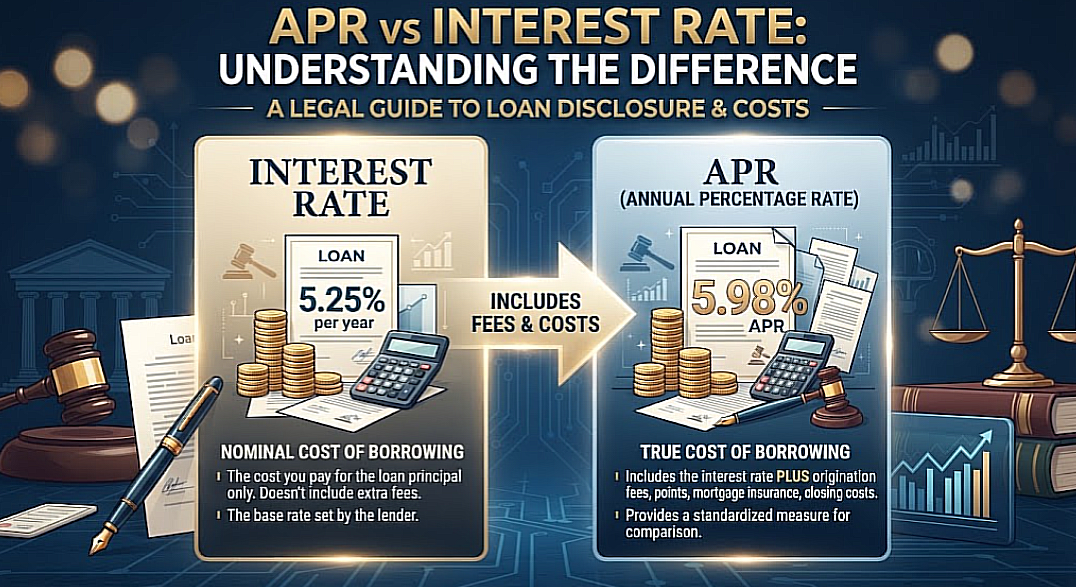
The interest rate generally tells you the rate charged for borrowing the principal. APR is a broader measure of the cost of credit that can incorporate certain fees and charges associated with obtaining the loan. The Consumer Financial Protection Bureau (CFPB) describes APR as a broader measure than the interest rate for many closed-end loans.
That difference matters when you're comparing financial products.
A loan advertised at 8% interest may not have an 8% APR. If the lender charges certain upfront fees, the APR can be higher because those costs are reflected in the APR calculation.
However, APR isn't a universal "total cost" number that includes every possible expense. What gets included can depend on the type of credit product and applicable disclosure rules. For example, mortgage APR calculations can account for the interest rate, points, mortgage broker fees, and certain other charges, while credit cards have their own APR and fee disclosures.
So, what's the difference between APR and interest rate, and which number should you pay attention to?
Let's break it down.
What Is an APR vs Interest Rate?
An interest rate is the percentage charged for borrowing money.
Suppose you borrow $10,000 at an annual interest rate of 8%. The 8% rate represents the cost of borrowing expressed as a yearly percentage.
The actual amount of interest you pay depends on factors such as:
- Your outstanding balance
- The loan term
- The repayment schedule
- How interest is calculated
- Whether the rate is fixed or variable
- How quickly you repay the balance
For an installment loan, you generally make scheduled payments toward principal and interest. As the principal balance falls, the amount of interest charged can also decline.
For example, consider a hypothetical $10,000 loan with an 8% annual interest rate.
The 8% figure tells you the borrowing rate. It doesn't necessarily tell you about every fee associated with getting the loan.
That's where APR becomes useful.
What Is APR?
APR stands for Annual Percentage Rate.
APR is designed to provide a broader way of expressing the cost of credit as an annual percentage.
For many loans, APR incorporates the interest rate along with certain finance charges or fees associated with obtaining the credit. The CFPB specifically explains that a loan APR can include the interest rate plus additional fees, such as origination charges.
Federal Regulation Z defines APR as a measure of the cost of credit expressed as a yearly rate.
This makes APR especially useful when you're comparing offers.
Imagine two lenders offer you similar loans:
Lender A | Lender B | |
|---|---|---|
Interest rate | 8.00% | 7.50% |
APR | 8.00% | 8.20% |
Upfront fees | Lower | Higher |
Looking only at the interest rate might make Lender B appear cheaper.
Looking at the APR gives you another piece of information about the cost of obtaining the credit.
That's why the CFPB advises consumers comparing loans to compare APR with APR, rather than comparing one lender's APR with another lender's interest rate.
APR vs. Interest Rate: The Main Difference
The simplest way to remember the difference is:
Interest rate = borrowing rate.
APR = broader annualized measure of credit cost.
For many installment loans, the APR can be higher than the interest rate because certain fees are reflected in the APR.
But there's an important wrinkle: APR doesn't necessarily include every cost you'll pay.
Depending on the product, you may still have costs that aren't represented in the APR.
For example, a credit card may have:
- Purchase APR
- Balance transfer APR
- Cash advance APR
- Annual fee
- Late payment fee
- Foreign transaction fee
- Other account fees
The CFPB notes that credit cards can have multiple APRs applying to different transaction types or periods, and that fees can be separate from APR.
So don't treat APR as a magical "everything you'll ever pay" number.
It's a comparison tool—not a substitute for reading the actual terms.
7 Key Differences Between APR and Interest Rate
1. Interest Rate Focuses on the Borrowing Rate
The interest rate primarily tells you the rate charged on the amount you borrow.
If a personal loan has a 10% interest rate, that 10% is the stated rate used to determine interest charges according to the loan's terms.
It doesn't necessarily tell you how much you'll pay in fees to obtain the loan.
2. APR Can Include Certain Fees
APR can incorporate certain fees or finance charges associated with obtaining credit.
For example, the CFPB explains that origination charges and other fees charged when a loan is made can affect a loan's APR.
This is one reason an offer might have:
Interest rate: 8%
but
APR: 8.75%
The difference doesn't necessarily mean the lender is secretly charging an additional 0.75% interest rate.
It can reflect how applicable fees affect the annualized cost of the credit.
3. APR Is Useful for Comparing Loan Offers
One of the biggest advantages of APR is that it gives consumers another standardized number for comparing credit offers.
Suppose you're shopping for an auto loan.
One lender offers:
- 7.25% interest rate
- 7.90% APR
Another offers:
- 7.50% interest rate
- 7.70% APR
If you looked only at the interest rate, the first offer appears cheaper.
But the APR tells you that fees and other applicable costs may change the comparison.
Federal Truth in Lending requirements generally require certain lenders to disclose APR for covered consumer credit transactions, helping consumers compare credit costs.
4. APR Can Be Higher Than the Interest Rate
For many closed-end loans, APR is often higher than the interest rate because certain fees are incorporated into the APR calculation.
For example:
Interest rate: 9.00%
APR: 9.65%
The difference can arise from costs associated with obtaining the loan.
Mortgage loans provide a common example. The CFPB explains that mortgage APR reflects the interest rate plus certain charges such as points, mortgage broker fees, and other charges.
5. APR Doesn't Always Include Every Fee
This is where borrowers can get tripped up.
A lower APR doesn't automatically mean you'll pay less in every situation.
Consider a credit card.
You might have:
- 22% purchase APR
- $95 annual fee
- 3% balance-transfer fee
- 5% cash-advance fee
The APR and fees are related to the overall cost of using the account, but they aren't simply one giant percentage that captures every possible charge.
The CFPB specifically points out that credit card fees can be separate from APR.
That's why you should examine the entire fee schedule and terms.
6. Credit Cards Treat APR Differently From Many Installment Loans
Credit cards are an especially important example because their APR structure can be more complicated.
A credit card might have different APRs for:
- Purchases
- Balance transfers
- Cash advances
- Certain promotional periods
The CFPB notes that different APRs can apply to different balances and transaction types.
For example, a card might advertise a promotional 0% APR for purchases for a limited period and then apply a different regular APR afterward.
So when evaluating a credit card, don't stop at the headline APR.
Look at:
- Which balance the APR applies to
- How long the promotional period lasts
- What happens after the promotion ends
- Annual fees
- Balance-transfer fees
- Cash-advance costs
- Late-payment terms
7. APR and Interest Rate Can Be Less Comparable Across Different Products
APR is useful, but you shouldn't blindly compare every APR you see.
A mortgage APR, credit card APR, auto-loan APR, and payday-loan APR can be calculated and disclosed under different rules and circumstances.
The product's structure matters.
For mortgages, for example, the CFPB warns that APR comparisons can require extra care when comparing adjustable-rate loans with fixed-rate loans or different types of credit products.
In other words:
APR is useful, but context still matters.
Simple Example: How Interest Rate and APR Can Differ
Let's use a hypothetical personal loan.
You borrow:
$10,000
The lender advertises:
Interest rate: 8%
Suppose the loan also has certain upfront fees.
Because those applicable costs affect the cost of obtaining the loan, the disclosed APR could be higher than 8%.
For illustration, imagine the APR is:
8.75%
The important thing isn't that you can simply subtract the two percentages and call the difference a "fee."
APR calculations involve the amount financed, timing of payments, and applicable finance charges.
Federal rules provide specific methods for determining APR rather than simply adding fees to the interest rate.
That's also why an APR calculator can be useful when you're trying to understand how different borrowing costs affect the effective annualized cost.
Why a Loan With a Lower Interest Rate Can Have a Higher APR
This sounds backwards at first.
How can one loan have a lower interest rate but a higher APR?
Fees.
Consider this simplified hypothetical comparison:
Loan A | Loan B | |
|---|---|---|
Interest rate | 7.50% | 7.25% |
Upfront fees | $100 | $700 |
APR | Lower | Potentially higher |
Loan B starts with a lower stated interest rate.
But if its upfront costs are substantially higher, those costs can affect its APR.
This is one reason consumers shouldn't automatically choose the offer with the lowest advertised interest rate.
At the same time, don't automatically choose the offer with the lowest APR either.
You should consider the actual loan amount, term, payment, fees, and how long you expect to keep the loan.
APR vs. Interest Rate on Credit Cards
Credit cards are slightly different.
For credit cards, the interest rate is typically stated as a yearly rate, and that rate is generally called the APR.
So you may see something like:
Purchase APR: 24.99%
In this context, the APR is essentially the annualized interest rate applicable to purchases under the card's terms.
But that doesn't mean your total cost of using the card is exactly 24.99%.
You could also have fees.
And if the card offers a promotional APR, that promotional rate may expire.
For example:
0% introductory APR for 15 months
could later become a regular APR stated in the card agreement.
The CFPB recommends paying close attention to when promotional APR periods end because the regular APR can apply afterward.
Can You Avoid Credit Card Interest?
Often, yes.
Many credit cards provide a grace period for purchases. If you pay the statement balance in full by the due date and meet the card's applicable terms, you may avoid interest on those purchases. The CFPB notes that most cards allow consumers to avoid purchase interest this way, although credit card issuers are not universally required to provide a grace period.
That's a big reason why simply looking at a credit card's APR isn't enough.
If you never carry a purchase balance, the purchase APR may matter less to your actual costs than it would for someone who carries debt month to month.
APR vs. Interest Rate on Personal Loans
Personal loans generally have a stated interest rate and APR.
The APR may be higher than the interest rate when applicable fees are incorporated into the APR calculation.
When comparing personal loans, look at:
- Interest rate
- APR
- Loan amount
- Loan term
- Monthly payment
- Origination fee
- Other mandatory fees
- Total repayment amount
- Prepayment terms
- Whether the rate is fixed or variable
Don't focus exclusively on the monthly payment.
A lower payment could simply mean you're taking longer to repay the debt.
That can increase the total interest paid.

APR vs. Interest Rate on Auto Loans
Auto loans are another situation where APR is particularly useful.
The CFPB explains that lenders and dealers must provide certain cost and term disclosures for covered auto loans under the federal Truth in Lending Act, including the APR.
When comparing two auto loans, compare:
APR → APR
rather than:
APR → interest rate
For example:
Dealer A | Dealer B | |
|---|---|---|
Interest rate | 6.99% | 7.25% |
APR | 7.40% | 7.30% |
Term | 60 months | 60 months |
The interest-rate comparison alone doesn't tell the whole story.
APR gives you another way to account for applicable credit costs.
But you should still review the complete financing disclosure and vehicle purchase terms.
APR vs. Interest Rate on Mortgages
Mortgage financing makes the distinction even more important.
Your mortgage interest rate is the rate used to calculate interest on your loan.
Your mortgage APR is broader.
The CFPB explains that mortgage APR can reflect the interest rate plus points, mortgage broker fees, and other charges associated with obtaining the mortgage.
For example:
Mortgage interest rate: 6.50%
Mortgage APR: 6.82%
The difference may reflect applicable costs incorporated into the APR.
When shopping for a mortgage, you can find the interest rate and APR in your Loan Estimate. The CFPB says the interest rate appears under "Loan Terms," while APR appears under "Comparisons."
Why Mortgage APR Needs Extra Attention
APR can be helpful, but mortgage comparisons aren't always as simple as choosing whichever lender displays the lowest APR.
For example, an adjustable-rate mortgage and fixed-rate mortgage have different risk and payment structures.
The CFPB specifically cautions consumers about comparing APRs across certain different loan types, including fixed-rate and adjustable-rate mortgages.
You should therefore examine:
- Interest rate
- APR
- Loan term
- Points
- Closing costs
- Monthly principal and interest
- Mortgage insurance
- Rate-adjustment terms, if applicable
- Expected time in the home
- Total borrowing costs
Is APR Always Higher Than the Interest Rate?
No.
For many closed-end loans, APR is often higher because certain fees are reflected in the calculation.
But you shouldn't assume that APR will always be higher in every financial product or situation.
Credit card APRs are a good example.
For many credit cards, the stated interest rate is itself expressed as an APR.
Also, APR calculations are governed by specific disclosure rules, and not every fee necessarily becomes part of the APR.
So the better rule is:
Don't assume the relationship. Check the specific product's disclosures.
Is a Lower APR Always Better?
Not necessarily.
This is one of the biggest misconceptions about APR.
Suppose you're comparing two loans.
Loan A:
- Lower APR
- Higher monthly payment
- Shorter term
Loan B:
- Slightly higher APR
- Lower monthly payment
- Longer term
Your choice could depend on your goals, budget, how long you expect to keep the loan, and total repayment costs.
Similarly, mortgage APR comparisons can become complicated when loan structures differ.
APR is a valuable comparison metric, but it shouldn't replace looking at the entire financing offer.
APR vs. Interest Rate: Which One Should You Look At?
The answer depends on what you're trying to determine.
If you're comparing loan offers
Look closely at APR because it can provide a broader comparison of borrowing costs.
If you're calculating interest charges
The interest rate is essential because it is used according to the loan's terms to determine interest.
If you're comparing credit cards
Look at the applicable APR for the type of balance you're carrying, plus fees and promotional terms.
If you're comparing mortgages
Look at both the interest rate and APR, along with points, fees, loan terms, and whether the rate is fixed or adjustable.
If you're comparing personal loans
Review both the interest rate and APR, then check the loan amount, term, fees, payment, and total repayment cost.
How to Compare Two Loan Offers Correctly
Here's a simple process you can use.
Step 1: Compare the Same Loan Amount
A $20,000 loan and a $30,000 loan aren't directly comparable just because their APRs look similar.
Start with the amount you're actually borrowing.
Step 2: Compare the Same Loan Term
A 36-month loan and a 72-month loan can produce very different total costs.
Try to compare offers with similar repayment periods.
Step 3: Compare Interest Rates
This tells you the stated rate used for borrowing costs.
Step 4: Compare APRs
APR gives you a broader annualized cost measure that can incorporate applicable fees.
Step 5: Check Fees Separately
Look for:
- Origination fees
- Annual fees
- Application fees
- Balance-transfer fees
- Late fees
- Prepayment-related charges
- Other disclosed costs
Step 6: Compare Monthly Payments
Make sure the payment fits your budget.
Step 7: Compare Total Repayment
This is crucial.
A loan with a lower monthly payment isn't automatically cheaper if you make payments for substantially longer.
Step 8: Check Whether the Rate Can Change
If the product has a variable or adjustable rate, understand how and when the rate can change.
How to Calculate APR
APR calculations can become complicated because they account for the relationship between the amount financed, finance charges, payment schedule, and timing of payments.
For certain closed-end credit transactions, federal Regulation Z specifies methods for determining APR, including actuarial and U.S. Rule methods.
For consumers, you generally don't need to manually reproduce the lender's regulatory APR calculation every time you compare a loan.
Instead, you can use the disclosed APR and compare equivalent offers.
If you're trying to understand the relationship between an interest rate, fees, loan amount, and payment schedule, an APR calculator can make the numbers easier to work through.
A Simple APR Calculation Concept
At a basic level, think of APR as asking:
"What does this credit actually cost me when the applicable borrowing costs and certain fees are considered on an annualized basis?"
The exact calculation is more sophisticated than:
Interest rate + fees = APR
That shortcut is not generally accurate.
APR calculations consider the timing and amount of payments and applicable finance charges.
That's why two loans with identical interest rates can potentially have different APRs.
APR, Interest Rate, and Total Cost Are Not the Same Thing
These three concepts are worth keeping separate:
Interest Rate
The stated borrowing rate.
APR
A broader annualized measure of credit cost that incorporates applicable charges under the relevant rules.
Total Cost
The actual dollars you pay over the life of the credit, including applicable interest, fees, and other costs.
They are related, but they aren't interchangeable.
Imagine borrowing $20,000.
You could have:
- 8% interest rate
- 8.5% APR
- $25,000 total repayment
Those numbers describe different aspects of the same borrowing arrangement.
The APR helps with comparison.
The interest rate helps describe the borrowing rate.
The total repayment tells you how many dollars ultimately leave your pocket under the assumed payment schedule.
Common Mistakes People Make With APR
Mistake 1: Assuming APR and interest rate are always identical
They're not necessarily identical, particularly for installment loans with applicable fees.
Mistake 2: Choosing the lowest advertised interest rate
A lower rate doesn't automatically mean the lowest overall borrowing cost.
Check the APR and fees.
Mistake 3: Assuming APR includes every fee
It doesn't necessarily.
Review the product's fee disclosures.
Mistake 4: Comparing APRs from completely different products
A mortgage APR and credit card APR aren't automatically interchangeable comparison numbers.
Product structure matters.
Mistake 5: Ignoring loan terms
A rate means little without knowing the repayment period.
Mistake 6: Forgetting promotional rates
A 0% or low introductory APR may only last for a specified period.
Check what happens afterward.
Mistake 7: Looking only at monthly payments
A smaller monthly payment can come with a longer repayment period and potentially higher total borrowing costs.
When Should You Use an APR Calculator?
An APR calculator can be useful when you want to understand how borrowing costs change based on different assumptions.
For example, you might compare:
- Different interest rates
- Different loan amounts
- Different fees
- Different loan terms
- Different payment schedules
Instead of doing the math manually, you can enter the relevant figures and estimate the resulting APR.
Just remember that a calculator provides an estimate based on the assumptions entered. A lender's disclosed APR can depend on the specific transaction and applicable regulatory calculation method.
APR vs. Interest Rate: Quick Comparison
Feature | Interest Rate | APR |
|---|---|---|
Measures borrowing cost | Yes | Yes |
Expressed annually | Usually | Yes |
Can reflect certain fees | Generally no | Often, depending on product |
Useful for comparing loans | Yes | Yes |
Always includes every fee | No | No |
Same as credit-card APR in many cases | Often | Yes |
Useful for mortgage comparison | Yes | Yes |
Should be considered with loan terms | Yes | Yes |

Conclusion
APR and interest rate are closely related, but they aren't always the same thing.
The interest rate primarily tells you the rate charged for borrowing money. APR provides a broader annualized measure of credit cost and can incorporate certain fees and finance charges, depending on the type of credit product and applicable rules.
For borrowers, the practical lesson is simple: don't judge a loan solely by its advertised interest rate.
When comparing similar offers, look at the APR, interest rate, fees, loan term, monthly payment, and total repayment cost.
And when you're dealing with credit cards, pay particular attention to which APR applies to purchases, balance transfers, or cash advances, as well as promotional periods and separate fees.
The numbers can look confusing at first, but once you understand what each percentage represents, comparing borrowing options becomes much easier.
And that's exactly where an APR calculator can come in handy: run the numbers, compare the assumptions, and see how the cost of borrowing changes before you commit.