

Buy Now, Pay Later: Is It Really Cheaper Than Using a Credit Card?
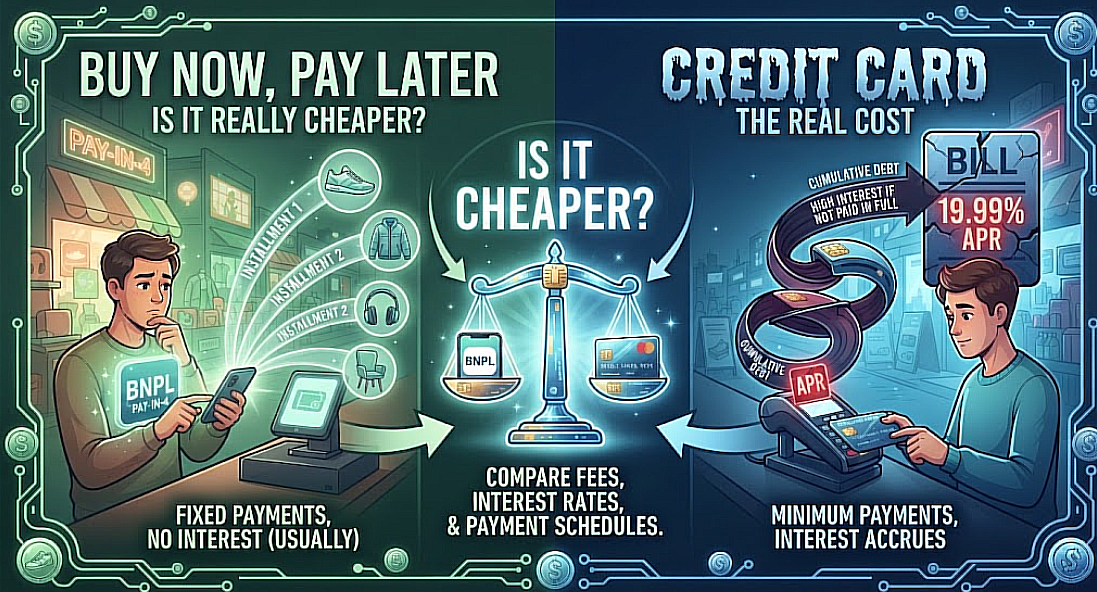
Buy Now, Pay Later (BNPL) has changed the way many consumers pay for purchases. Instead of paying the full price immediately, shoppers can divide a purchase into several installments, sometimes with no interest. The option can appear especially attractive when a checkout page presents a $200 purchase as four payments of $50. But is BNPL actually cheaper than using a credit card?
The answer depends on how the purchase is financed, whether fees apply, how quickly the balance is repaid, and what happens if payments are missed. A BNPL plan can be less expensive than carrying a credit card balance at a high interest rate, but that does not automatically make it the better financial choice. If a shopper uses BNPL for purchases they cannot comfortably afford, the convenience can turn into a budgeting problem.
Understanding the differences between BNPL and credit cards can help consumers make better decisions. The key is to look beyond the advertised installment amount and consider the total cost, repayment schedule, fees, credit impact, and effect on your overall budget.
What Is Buy Now, Pay Later?
Buy Now, Pay Later is a form of short-term financing that allows consumers to purchase goods or services immediately and repay the amount over time.
A typical BNPL arrangement may divide a purchase into several installments. For example, a $400 purchase might be split into four payments of $100. Depending on the provider and plan, the consumer may pay no interest when payments are made according to schedule.
BNPL is commonly offered during online checkout, although some providers also support in-store purchases. The financing may be available for clothing, electronics, furniture, travel, groceries, beauty products, and other purchases.
The basic attraction is simple: instead of paying $400 today, a shopper sees a smaller payment that appears easier to manage.
However, the smaller individual payment does not change the underlying price of the purchase. You still owe the full amount, just on a different schedule.
That distinction is important.
How Does BNPL Work?
Although individual providers have different terms, a basic BNPL transaction generally follows a straightforward process.
A shopper selects BNPL at checkout and applies for financing. If approved, the provider may pay the merchant while the customer agrees to repay the provider according to the installment schedule.
For example:
- Purchase price: $300
- Number of installments: 4
- Scheduled payment: $75
- First payment: At or shortly after purchase
- Remaining payments: According to the provider's schedule
If the plan has no interest or applicable fees, the customer may repay exactly $300.
But the calculation can change if the plan includes interest, late fees, account fees, or other charges.
This is why consumers should read the terms before accepting the financing rather than assuming every BNPL plan is completely free.
Why Does BNPL Look Cheaper?
BNPL often looks cheaper because the cost is presented as a series of small payments rather than as one large expense.
Imagine someone wants to buy a $1,000 television. Paying $1,000 immediately may feel expensive. A BNPL option could instead display four payments of $250.
The total is still $1,000.
The psychological difference can be significant.
A consumer may think, "I can afford $250," without asking whether they can actually afford the $1,000 purchase.
This is one of the biggest financial risks of installment-based shopping. The payment amount may be manageable while the purchase itself is unnecessary or unaffordable.
BNPL therefore changes the timing of payment, not necessarily the affordability of the product.
Is BNPL Cheaper Than a Credit Card?
Sometimes, yes.
But the comparison depends heavily on how the credit card is used.
Consider two consumers purchasing a $1,000 item.
Consumer A: BNPL
The consumer uses a four-installment BNPL plan with no interest and no applicable fees.
Total repayment:
$1,000
Consumer B: Credit Card Paid in Full
The consumer puts the $1,000 purchase on a credit card and pays the entire statement balance by the due date, assuming the card's terms provide a grace period for purchases.
Total purchase cost:
$1,000
In this situation, BNPL does not necessarily save money. Both financing methods can result in the same purchase price.
Now consider a different situation.
Consumer C: Credit Card Balance Carried Over
The consumer charges $1,000 to a credit card but cannot pay the balance in full. Interest begins accruing according to the card's terms.
The final amount paid could be significantly higher than $1,000.
In that scenario, an interest-free BNPL plan could potentially cost less than carrying the same purchase on a credit card.
But there is another important question:
Would the consumer have made the purchase at all if financing were not available?
If the answer is no, BNPL may still be financially harmful even if its financing cost is lower.
BNPL vs. Credit Cards: The Main Differences
BNPL and credit cards both allow consumers to obtain something now and pay later, but they operate differently.
Payment Structure
BNPL generally uses a fixed installment schedule. You know the amount and timing of upcoming payments when you accept the plan.
Credit cards provide revolving credit. You can generally make purchases, repay some or all of the balance, and continue using available credit.
This flexibility can be useful, but it can also make it easier to accumulate debt.
Interest
Some BNPL plans do not charge interest when payments are made according to their terms. Other BNPL products may involve interest or different financing structures.
Credit cards can charge interest when balances are carried beyond applicable grace periods, and the rate can be substantial depending on the card and account terms.
Therefore, consumers should compare the actual financing terms rather than assuming one category is always cheaper.
Fees
BNPL plans can involve late fees or other charges depending on the provider and product.
Credit cards can have several potential fees, including annual fees, late payment fees, balance transfer fees, cash advance fees, and other charges depending on the card.
The correct comparison is not "BNPL has no interest" versus "credit cards charge interest."
Instead, ask:
How much will this specific transaction actually cost me under each option?
Repayment Flexibility
Credit cards generally offer greater flexibility because consumers can choose to pay the full statement balance or a smaller amount, subject to the card agreement.
BNPL generally requires payments according to a predetermined schedule.
The fixed structure can make budgeting easier, but it also means a consumer must account for the upcoming installments.
The Hidden Problem: Stacking BNPL Payments
One of the biggest problems with BNPL is not necessarily the cost of one transaction.
It is the accumulation of several transactions.
Imagine someone makes these purchases during one month:
- Shoes: $120
- Headphones: $180
- Clothing: $240
- Household items: $160
Instead of paying $700 immediately, the consumer uses separate installment plans.
Each individual payment may look small.
But several weeks later, the person could have multiple payments leaving their bank account at the same time.
This is sometimes called payment stacking.
The danger is that consumers may evaluate each purchase individually without considering their total outstanding obligations.
A $30 payment may seem harmless.
Five different $30 payments are $150.
And those payments can arrive alongside rent, utilities, groceries, transportation costs, insurance, subscriptions, and other financial commitments.
Can BNPL Hurt Your Budget?
Yes.
BNPL can make a purchase easier to pay for without making it easier to afford.
That distinction is crucial.
Suppose someone has $500 available for discretionary spending. They use BNPL to purchase a $400 product and feel comfortable because only part of the amount is due immediately.
But that $400 still represents a commitment against future income.
If unexpected expenses appear, the consumer may struggle to make the scheduled installments.
A good budget should therefore treat the entire purchase price as committed money, not just the next installment.
Before using BNPL, ask:
- Could I pay the full purchase price today if necessary?
- Is this purchase already included in my budget?
- How many other installment payments do I currently have?
- Will future payments interfere with essential expenses?
- What happens if my income falls unexpectedly?
- What fees apply if I miss a payment?
If the purchase only appears affordable because the payment has been divided into smaller amounts, caution is warranted.
What Happens If You Miss a BNPL Payment?
The consequences depend on the specific provider and agreement.
Potential consequences can include:
- Late fees
- Restrictions on future BNPL purchases
- Account suspension
- Collection activity
- Potential credit reporting
- Other consequences described in the financing agreement
Not every BNPL product treats missed payments in exactly the same way.
Consumers should therefore review the provider's terms before accepting a plan.
A missed payment can also create a chain reaction. If the consumer uses multiple BNPL accounts and one payment causes a shortage of available cash, another payment may become difficult as well.
This is another reason to avoid treating installment payments as free money.
Does BNPL Affect Your Credit Score?
It can, depending on the provider, product, and circumstances.
Some BNPL providers may use different types of credit checks or reporting practices from traditional credit card companies. Certain products or payment behavior may be reported to credit bureaus, while others may not be reported in the same way.
Because practices can vary, consumers should not assume that BNPL has either no effect or the same effect as a credit card.
Before using a BNPL product, check whether:
- An application involves a credit check
- The account is reported to credit bureaus
- On-time payments are reported
- Missed payments are reported
- The provider reports to one or multiple credit bureaus
Understanding these details is especially important for someone trying to build or protect a credit history.
When BNPL May Make Financial Sense
BNPL can be reasonable in certain situations.
For example, suppose you need to replace an essential household item and have already budgeted for it. The retailer offers a genuinely interest-free installment plan with no applicable fees, and you have enough income to comfortably make every payment.
In that case, spreading payments over a short period may help with cash-flow management.
The important point is that the consumer should already be able to afford the purchase.
BNPL can be viewed as a payment-management tool rather than a way to make an otherwise unaffordable purchase possible.
A potentially sensible use generally has several characteristics:
- The purchase is necessary or already planned.
- The total price fits within the budget.
- The repayment schedule is short and clear.
- The consumer understands all applicable fees.
- Existing installment obligations are manageable.
- There is enough income or savings to cover unexpected expenses.
When BNPL May Be a Bad Idea
BNPL becomes more concerning when it is used to finance discretionary spending that the consumer cannot otherwise afford.
Warning signs include:
- You need BNPL to buy basic necessities because cash is insufficient.
- You are using one BNPL plan to make payments on another obligation.
- You have several active installment plans.
- You are frequently missing payments.
- You are buying something primarily because the monthly payment looks small.
- You do not know the total amount you owe.
- You are relying on your next paycheck to cover multiple upcoming payments.
- You would not buy the product if installment financing were unavailable.
These situations suggest that the issue may be broader than the payment method.
It may indicate a need to reassess the overall budget.
BNPL vs. Credit Card: Which Is Better?
There is no universal winner.
The better option depends on the transaction, repayment behavior, and terms.
Factor | BNPL | Credit Card |
|---|---|---|
Typical structure | Fixed installments | Revolving credit |
Payment schedule | Usually predetermined | Flexible within account terms |
Interest | May be zero or applicable depending on product | May apply when balances are carried |
Fees | May include late or other fees | May include several types of fees |
Credit impact | Depends on provider/product | Generally tied to credit reporting |
Reusable credit | Usually transaction-specific | Yes |
Risk of overspending | Can be high due to small payments | Can be high due to revolving credit |
Best use | Planned purchases with manageable installments | Purchases paid responsibly within card terms |
The most important factor is not the label attached to the financing.
It is whether the consumer pays the balance responsibly and understands the total cost.
What About Credit Card Rewards?
Credit cards can have another advantage: rewards.
Some cards offer cash back, points, miles, or other benefits for eligible purchases.
Suppose a consumer can afford a $500 purchase and will pay the credit card statement balance in full. A rewards card may provide a financial benefit that a BNPL plan does not.
But rewards should never justify unnecessary spending or carrying a high-interest balance.
A $10 reward is not a good deal if it encourages $500 of debt that accrues significant interest.
The correct order is:
Affordability first, financing cost second, rewards third.
Don't Compare Monthly Payments—Compare Total Cost
One of the best ways to compare BNPL and credit cards is to ignore the advertised monthly payment initially.
Instead, calculate the total amount you expect to pay.
For a BNPL plan, consider:
Total Cost = Purchase Price + Interest + Applicable Fees
For a credit card, consider:
Total Cost = Purchase Price + Interest + Applicable Fees − Relevant Rewards
The actual calculation depends on the account terms and repayment behavior.
For example, if a $600 purchase can be financed through a four-payment BNPL plan with no interest or applicable fees, the total could remain $600.
If the same $600 is placed on a credit card and paid in full under applicable grace-period terms, the purchase may also cost $600 before considering rewards or card-specific fees.
But if the credit card balance is carried and interest accumulates, the final cost can increase.
This is why the repayment plan matters more than the payment method's name.
A Simple BNPL Affordability Test
Before selecting BNPL, use a simple three-question test.
1. Can I afford the full purchase?
Do not ask whether you can afford the next installment.
Ask whether the entire purchase fits comfortably within your financial situation.
2. Can I make every payment without relying on new debt?
If you need another loan, credit card advance, or BNPL plan to make the upcoming payment, the original purchase may not be affordable.
3. Would I still buy it without BNPL?
This is perhaps the most useful question.
If splitting the payment changes a "no" into a "yes," pause before completing the purchase.
The financing option may be influencing the decision more than the actual value of the product.
How to Use BNPL Without Losing Control
If you decide to use BNPL, treat it like any other financial obligation.
Track Every Active Plan
Keep a list of all outstanding BNPL purchases, including:
- Original purchase amount
- Remaining balance
- Upcoming payment dates
- Remaining installments
- Applicable fees
A simple spreadsheet or budgeting app can help.
Set Aside the Full Amount
If possible, mentally or physically reserve the money required for future payments.
This prevents the money from being accidentally spent elsewhere.
Avoid Multiple New Plans
Taking out one installment plan may be manageable.
Taking out five or six at once makes your financial picture much harder to track.
Read the Terms
Look for information about:
- Interest
- Late fees
- Payment dates
- Refunds
- Returns
- Missed payments
- Credit reporting
- Early repayment
- Dispute procedures
Never assume that every provider uses the same rules.
What Should You Use for a Large Purchase?
For a large purchase, the first question should not be whether to use BNPL or a credit card.
It should be whether you should make the purchase now.
If the item is necessary and already budgeted for, compare the financing options based on their actual costs and risks.
If the item is optional and financing is the only reason it seems affordable, waiting and saving may be the stronger financial choice.
Saving $100 per month for five months to buy a $500 product may be less exciting than clicking "Pay in 4," but it eliminates the future payment obligation.
Sometimes the cheapest financing option is no financing at all.
BNPL and Emergency Expenses
Consumers should also be careful about using BNPL for emergencies.
A broken appliance, urgent repair, or unexpected expense can create pressure to find immediate financing.
BNPL may appear attractive because it divides the expense into manageable payments.
But if the emergency occurred because there was no cash reserve available, adding another monthly obligation may create additional financial stress.
Building an emergency fund can reduce the need to rely on short-term financing when unexpected expenses arise.
That does not mean every emergency can be covered by savings. It simply means that having accessible reserves can give consumers more choices.
The Psychological Side of "Small Payments"
BNPL is not only a financial product. It also changes how prices feel.
A $1,200 purchase sounds expensive.
Twelve payments of $100 may sound much easier.
But the underlying obligation has not disappeared.
This payment framing can make consumers more willing to purchase expensive products, particularly when the checkout process emphasizes the installment amount instead of the total price.
Consumers can counter this effect by deliberately converting every installment plan back into its full purchase price.
Instead of thinking:
"$75 today."
Think:
"$300 purchase, with four scheduled payments of $75."
That small mental adjustment can make financial decisions much clearer.
Conclusions
Buy Now, Pay Later is not automatically cheaper than a credit card, and a credit card is not automatically more expensive than BNPL.
The answer depends on the specific financing terms and, perhaps even more importantly, how the consumer repays the balance.
A genuinely interest-free BNPL plan may be cheaper than carrying a credit card balance that accrues interest. But if the credit card is paid in full under applicable terms, the difference may be minimal, and rewards or other benefits could make the credit card attractive for an already-budgeted purchase.
The bigger danger is using either product to buy things that are not affordable.
Before choosing BNPL, look at the total purchase price, not just the installment amount. Check interest and fees, understand the payment schedule, consider how the payments fit alongside existing obligations, and think carefully about whether you actually need the purchase.
BNPL can be a useful payment tool when used deliberately. But a smaller payment does not mean a smaller purchase.
The smartest approach is to make affordability the first question, financing the second, and convenience the last.