

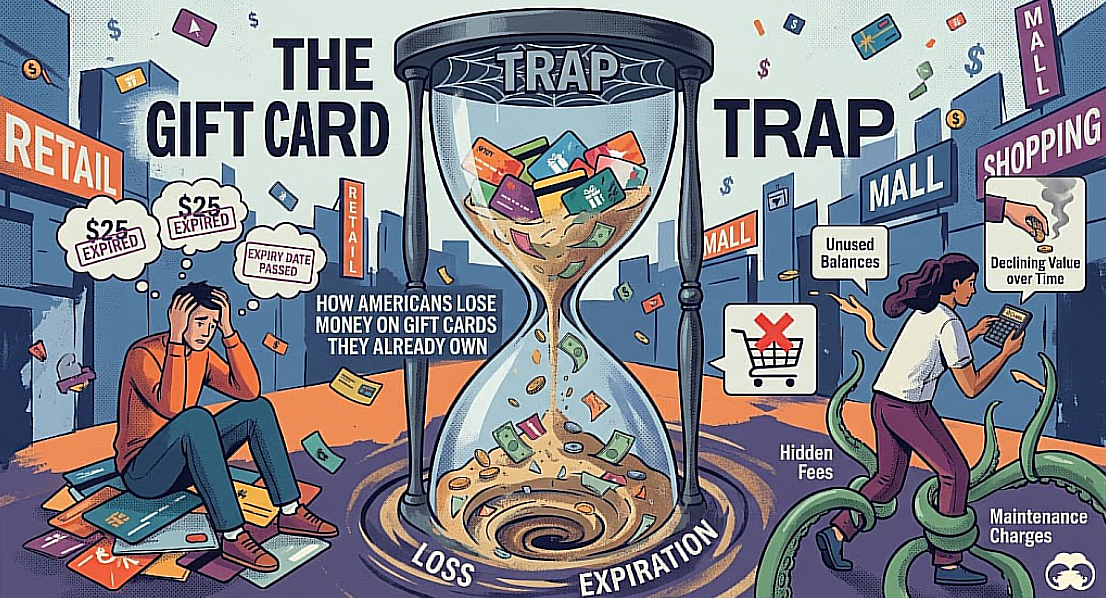
You Already Own This Money: How Forgotten Gift Cards Quietly Drain Your Wallet
A gift cards can feel like free money. Someone gives you a $50 card for your birthday, you receive a $25 store credit after a purchase, or a relative sends an electronic gift card during the holidays. You tuck it into a drawer, save the email for later, or tell yourself you will use it the next time you shop.
Then life gets busy.
Months pass. The card gets buried beneath receipts, the email disappears into your inbox, or the retailer’s app gets replaced by another shopping app. Eventually, you forget the gift card exists. The money is still technically yours, but it is not doing you any good.
This small oversight can become a surprisingly common money leak. A single forgotten $15 balance might not seem important. Several unused cards worth $20, $35, or $50 each can add up to money that could have paid for groceries, household essentials, a meal, or another planned expense.
The problem is not always that gift cards expire or that retailers take the money away. Sometimes the real problem is simpler: consumers forget to use value they already have. Other times, confusing terms, lost access to digital accounts, retailer closures, or misunderstandings about expiration rules make redemption harder than expected.
The good news is that a little organization can help you recover forgotten balances and prevent new ones from disappearing. Here is how to find the gift cards you already own, understand the rules that protect them, and make sure future gifts do not become another source of wasted money.
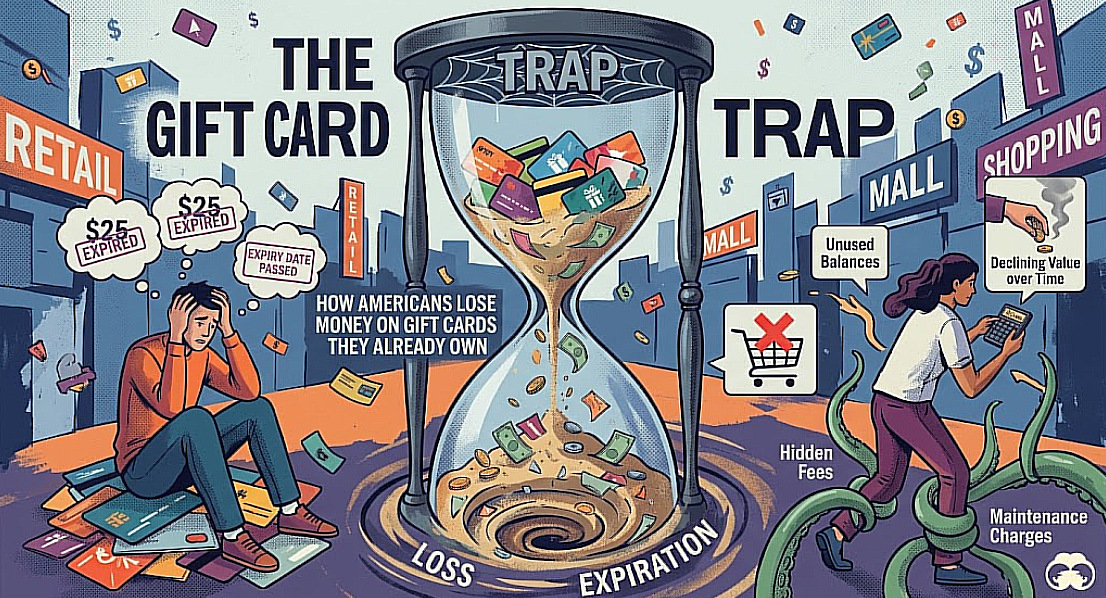
Why Gift Cards Are So Easy to Forget
Gift cards occupy an unusual place in a household budget. They represent money, but they often do not feel like money in the same way cash in a wallet or funds in a checking account do.
When you receive cash, you can immediately see how it might fit into your spending plan. A gift card, however, is usually tied to a particular store, restaurant, service, or payment network. That restriction makes it feel less flexible.
A $40 card for a clothing retailer does not necessarily help with this week's groceries. A restaurant gift card may be useful only when you plan to eat at that restaurant. A digital card for an online store may require you to locate a code before checking out.
As a result, people often mentally separate gift cards from their regular money. They might remember the card when they are already shopping at the right retailer, but forget it when they are planning their overall spending.
Several habits make the problem worse.
Gift cards become disconnected from everyday finances
Most people track money in bank accounts, budgeting apps, spreadsheets, or monthly statements. Gift cards may not appear in any of those places.
If a person has $75 in a bank account and $45 spread across three gift cards, they may think only about the bank balance when deciding whether they can afford a purchase. The gift card money remains invisible until the right shopping opportunity appears.
That disconnect can lead to unnecessary spending. Someone might pay $30 out of pocket at a store while a forgotten gift card for the same retailer sits at home.
Small balances seem unimportant
A gift card with $4.63 remaining may not feel worth tracking. Consumers may decide to save it for later, only to forget about it entirely.
The same thing happens with cards carrying larger amounts. People often focus on the original value rather than the current balance, especially after making several purchases with a card.
Yet small balances are still real money. Five unused cards with $8 left on each represent $40. Ten cards with $12 remaining represent $120.
The challenge is not that every small balance deserves a separate budgeting system. It is that several small amounts can become meaningful when they accumulate.
Digital gift cards disappear into email
Electronic gift cards are convenient because they do not require a physical card. They can be delivered almost instantly and stored on a phone.
But convenience can also make them easy to lose track of.
A digital gift card might arrive in an email with a generic subject line. It may be sent by a third-party gifting service rather than directly by the retailer. The recipient might open the message, appreciate the gift, and then leave it unread or archive it.
Later, searching for the card can become difficult because the recipient cannot remember who sent it, which service delivered it, or what the email subject said.
The original occasion disappears from memory
Gift cards are frequently given for birthdays, holidays, graduations, workplace rewards, thank-you gifts, and special occasions. Because they arrive as occasional gifts rather than regular income, they may not become part of a person's routine.
A card received in December can easily be forgotten by spring. A workplace reward issued during a busy month may sit unused for a year.
Without a simple reminder system, even a generous gift can fade into the background.
How Much Money Could Be Sitting in Forgotten Gift Cards?
There is no single amount that applies to every household. The value depends on how often people receive gift cards, how many they redeem, and whether they keep track of the remaining balances.
Still, a simple example shows why the issue deserves attention.
Imagine a household with the following unused balances:
Gift card | Remaining balance |
|---|---|
Clothing store | $25 |
Restaurant | $18 |
Online retailer | $30 |
Coffee shop | $12 |
General-purpose gift card | $40 |
Total | $125 |
None of these balances is especially large on its own. Together, they represent $125 in purchasing power.
Now imagine the household has another $35 spread across old cards and digital accounts. The total becomes $160.
That money may not be available for every expense, because each card has its own restrictions. But it can still replace spending the household would otherwise make with cash or a debit card.
If the family was already planning to buy clothes from the retailer on the first card, using that balance reduces the amount it needs to pay out of pocket. If the restaurant card covers a meal the family intended to purchase anyway, it frees up money for another purpose.
The important distinction is between money that replaces planned spending and money that encourages additional spending.
A gift card is most valuable when it helps cover something you already intended to buy. It is less helpful when it persuades you to purchase something unnecessary simply because the card is available.
The Hidden Spending Trap: A Gift Card Can Make You Spend More
Unused gift cards are not only an organizational problem. They can also change shopping behavior.
Suppose you have a $50 gift card for a clothing store. You visit the store intending to buy a $25 item, but you notice a jacket priced at $85. Because you have the gift card, you convince yourself that spending $35 out of pocket is reasonable.
You may have received a gift worth $50, but you have also spent money you did not originally plan to spend.
That does not automatically make using the card a bad decision. If the jacket is something you genuinely need and the price fits your budget, the purchase may make sense. The risk arises when the gift card becomes a reason to justify unnecessary spending.
Retailers may also encourage shoppers to spend beyond the balance on a card. A checkout page might display products just above the card's value, or a promotion may make an additional purchase seem like a bargain.
Consider a $30 gift card. If you buy a $45 item because you want to use the entire balance, you still pay $15 yourself. If you would never have bought the item without the gift card, the transaction has not necessarily saved you money.
A better approach is to ask three questions before redeeming a card:
- Would I buy this item if I did not have the gift card?
- Is this purchase already part of my spending plan?
- Will using the card reduce money I would otherwise spend, or will it create a new expense?
A gift card should support your spending decisions, not make them for you.
Do Gift Cards Expire in the United States?
One of the biggest reasons people abandon old gift cards is the assumption that they have already expired.
The rules are more protective than many consumers realize, although the details depend on the type of card and applicable state law.
Under federal law, covered gift certificates, store gift cards, and general-use prepaid cards generally cannot have their underlying funds expire earlier than five years after the card is issued or, for reloadable cards, the funds were last loaded. Federal rules also limit when inactivity fees can be charged. Certain promotional or loyalty cards may fall outside some of these protections. <Link url="https://www.consumerfinance.gov/rules-policy/regulations/1005/20/" title="The Consumer Financial Protection Bureau's gift card regulation"/> explains the relevant requirements. <Cite refs={["turn913817search6","turn913817search4"]} />
There is an important distinction between a card's expiration date and the expiration of the money loaded onto it. A physical or prepaid card may reach the end of its usable life while the remaining funds are still protected. In some circumstances, the issuer must provide information about obtaining a replacement card or accessing the remaining balance.
That means an expired card should not automatically be treated as worthless. Check the card's terms and contact the issuer to find out whether a replacement or balance transfer is available. The Consumer Financial Protection Bureau also explains that certain prepaid cards may have replacement or balance-access options when the card itself expires. <Link url="https://www.consumerfinance.gov/ask-cfpb/if-my-prepaid-card-expires-do-i-lose-my-money-en-423/" title="Read the CFPB's guidance on expired prepaid cards"/>. <Cite refs={["turn913817search11","turn913817search6"]} />
State laws may provide additional protections
Federal rules establish a baseline, but state gift card laws can differ. Depending on where the card was purchased or issued and which law applies, state rules may offer additional protections involving expiration dates, fees, or remaining balances.
Consumers should not assume that every card follows identical rules. Promotional certificates, loyalty rewards, prepaid payment cards, and ordinary gift cards may be treated differently.
If a retailer claims that an old card is invalid, check the terms and the relevant state consumer-protection guidance before giving up. The answer may depend on the card's type, when it was issued, and the circumstances of the claim.
Inactivity fees have limits
Federal rules generally restrict dormancy, inactivity, or service fees on covered gift cards. For example, an inactivity fee cannot generally be imposed unless the card has had no activity for at least one year, required disclosures are provided, and no more than one such fee is imposed in a calendar month. Specific exceptions apply to certain promotional products. <Cite refs={["turn913817search6","turn913817search7"]} />
This does not mean that every card is fee-free in every situation. It means consumers should examine the applicable terms rather than assume a retailer can simply deduct money whenever a card sits unused.
If a balance has decreased unexpectedly, ask the issuer for a transaction history and an explanation of any deductions. Keep the response and the card's terms in case you need to raise a complaint with the relevant consumer-protection agency.
What Happens When a Business Closes?
A more difficult situation arises when a retailer shuts down, files for bankruptcy, or stops accepting its gift cards.
A gift card is generally a promise from the issuer or merchant to provide goods, services, or another form of redemption. If the business can no longer fulfill that promise, the cardholder's options may become more complicated.
However, a store closure does not automatically mean every card becomes worthless immediately. The outcome can depend on whether the business is temporarily closed, whether another company has taken over its operations, whether the gift card program is being honored, and what happens during bankruptcy proceedings.
If a retailer announces that it is closing, cardholders should look for official instructions as soon as possible. They should not rely solely on social media posts or rumors.
Practical steps include:
- Check the retailer's official website for announcements about gift card acceptance.
- Review emails or notices explaining any deadlines or redemption restrictions.
- Contact customer service while the company is still operating, if possible.
- Save the card number, balance information, receipt, and relevant communications.
- If bankruptcy is involved, consult official court or trustee information before assuming the card can be redeemed or refunded.
Do not pay an unfamiliar third party who promises to recover a gift card balance for an upfront fee. That offer could create a second financial loss on top of the first.
How to Find Gift Cards You Have Forgotten
Recovering forgotten balances starts with a search. You do not need an elaborate financial system; you need a reliable way to gather the cards in one place.
1. Search your email
Start with your primary email account and any other addresses you regularly use.
Search terms such as these can uncover electronic cards and delivery messages:
- Gift card
- E-gift
- Gift certificate
- Voucher
- Redeem
- Reward
- Digital gift
- Balance
- Order confirmation
Search for specific retailers, restaurants, and gifting services too. A card may have been sent by a platform whose name you no longer remember.
Check archived messages, spam folders, and older email accounts where you may have received gifts in previous years. If you find a card, verify that the message is legitimate before clicking links or entering personal information.
2. Check your phone's wallet and shopping apps
Digital cards may be stored in a phone's digital wallet, a retailer's app, or a third-party gift card application.
Review the apps you actually use and look for saved cards, reward balances, promotional credits, and electronic receipts. Some balances may be attached to an account rather than represented by a separate card image.
If you no longer have access to an old phone, check whether the relevant service allows you to sign in from another device. Avoid sharing passwords or verification codes with anyone offering to locate a balance for you.
3. Look through physical storage
Search the places where you normally keep small items: wallets, desk drawers, filing cabinets, purses, gift bags, and boxes of holiday cards.
Physical gift cards can hide in plain sight. A card may be tucked inside a birthday card or stored with a receipt from the day it was received.
Gather every card before checking balances. That makes it easier to see what you own and reduces the chance of finding the same card multiple times during separate searches.
4. Review reward and loyalty accounts
Some employers, retailers, and loyalty programs issue rewards that resemble gift cards but follow different terms.
Check old reward emails and accounts you still use. Look for remaining promotional credits, points that can be converted into gift cards, and rewards that may have separate expiration rules.
Do not assume that all rewards receive the same legal protections as a gift card purchased with money. Read the terms attached to the specific program.
5. Record the balances
Once you find your cards, make a simple list containing the retailer, remaining balance, card location, and any relevant restrictions.
For digital cards, you may also record where the code is stored. For physical cards, note where you keep them.
Avoid recording full card numbers, PINs, or redemption codes in an unprotected document. Treat gift card credentials like cash: anyone who obtains them may be able to use the balance.
A Simple Gift Card Recovery Plan
You can organize your cards in less than an hour if you keep the process straightforward.
Step | What to do | Why it helps |
|---|---|---|
Find | Search email, apps, wallets, and drawers | Reveals forgotten cards |
Verify | Check the balance with the official issuer | Establishes the amount still available |
Sort | Group cards by retailer, purpose, or restriction | Makes redemption easier |
Plan | Match balances to purchases you already expect | Reduces out-of-pocket spending |
Redeem | Use the card for a planned purchase | Turns unused value into practical savings |
Track | Update the remaining balance | Prevents another round of forgotten money |
If you have many cards, prioritize those with larger balances, confusing terms, or possible restrictions. That does not mean smaller balances should be ignored; it simply gives you a useful starting point.
For example, a $75 general-purpose gift card might be easier to use than a $7 balance at a specialty store. Redeem the flexible card for a planned expense first, then look for a sensible opportunity to use the smaller one.
The goal is not to spend every card immediately. It is to make sure you know what you own and have a reasonable plan for using it.
Should You Sell, Exchange, or Regift an Unwanted Card?
Sometimes the problem is not forgetfulness. You remember the card perfectly well, but the retailer is irrelevant to your life.
A card for a store you never visit may remain unused indefinitely. In that situation, exchanging it, selling it through a reputable service, or regifting it may be more practical than holding onto it.
Before doing so, consider the trade-offs.
Selling a gift card
Gift card resale services may let you exchange a card for cash or another payment method. However, the amount offered may be less than the card's face value.
A $100 card might attract an offer below $100 because the resale service needs to account for demand, verification, and operating costs. Compare the net amount you would receive with the likelihood that you will use the card yourself.
Research any service before sharing card details. Check its fees, payment process, refund policies, and reputation. Never send a redemption code to a stranger who promises to pay later without meaningful protections.
Exchanging a gift card
Some platforms allow users to exchange unwanted cards for cards from other retailers. This may be useful if you prefer a different store, but the exchange value may be lower than the original balance.
Read the terms carefully and verify whether the replacement card has restrictions of its own. Do not trade a card simply because the platform makes the exchange look convenient.
Regifting a gift card
If the card is valid, transferable, and appropriate for someone you know, regifting may be an easy option. Confirm the balance first and disclose any restrictions that matter.
You should also make sure the card has not been personalized, tied to an account, or otherwise restricted from transfer. Keep the handoff simple and honest.
In every case, compare the alternatives with the realistic chance that you will use the card. A card that is likely to sit unused for years may be worth exchanging for something you can use now, even if you do not recover every dollar of its stated value.
Avoid Gift Card Scams While Trying to Recover Your Money
Gift cards are attractive targets for scammers because the codes can function much like cash. Once a balance is redeemed by someone else, recovering the money may be difficult.
Be especially cautious when searching online for ways to check or recover a balance. Fraudulent websites may imitate retailer pages or offer fake customer-service numbers. Some may ask for the full card number and PIN under the pretense of verifying the card.
Use the retailer's official website or a customer-service number obtained from a trusted source. Do not rely on a phone number found in a random search result or sent to you by an unknown person.
Remember these warning signs:
- Someone demands gift card payment to resolve a tax bill, legal problem, utility bill, or emergency.
- A supposed customer-service agent asks you to reveal the code and PIN unnecessarily.
- A recovery service promises guaranteed results in exchange for an upfront fee.
- A buyer pressures you to send a card code before payment is confirmed.
- A message claims your gift card will be deleted unless you act through an unfamiliar link.
Legitimate organizations do not require you to pay ordinary taxes, fines, or unexpected bills using retail gift cards. If you suspect fraud, save relevant messages and transaction details, contact the card issuer promptly, and report the incident to the appropriate authorities.
How to Stop Losing Track of Gift Cards
Finding old cards is useful, but building a small habit can prevent the problem from returning.
Create one gift card location
Keep physical cards together in a labeled envelope, wallet section, or secure organizer. Store them somewhere easy to find, but not where visitors can access them.
For digital cards, use a dedicated email label or folder. If your phone supports saved cards, make sure you know where they are stored and how to access them.
The best system is the one you will actually use. There is no need to build a complicated spreadsheet if a simple list works.
Add cards to your spending routine
When you receive a card, record it immediately and decide how you might use it. If it is for a retailer you visit regularly, consider keeping it with your shopping list or adding a reminder to check the balance before your next purchase.
A reminder can be as simple as a monthly calendar notification to review your gift card list. The point is to bring the money back into view.
Check balances after each purchase
If a card is partially used, record the remaining amount or save the receipt. Otherwise, the original value can become misleading.
A card that began with $100 may now contain only $14.70. Knowing the exact balance makes it easier to decide whether the card can cover a planned purchase or needs to be combined with another payment method.
Avoid buying extra items just to empty a card
It can be tempting to spend the entire balance in one visit, especially when only a small amount remains. But using every last cent is not always the smartest financial decision.
If the card has $6 left and you need nothing from that retailer, spending $25 to avoid leaving $6 unused is not a saving. It is an additional expense.
Use the balance when it fits your needs. If the remaining amount is too small to be practical, check whether the retailer permits partial payment or whether another legitimate redemption option exists.
Include gift cards in your financial checkup
A monthly or quarterly review of gift cards can be part of a broader household money routine. You might check them alongside loyalty rewards, store credits, refunds, and other balances that are easy to overlook.
This does not require treating every gift card like a bank account. It simply means recognizing that these balances can offset purchases you would otherwise pay for yourself.
For more practical consumer-money guidance, explore Finiuo. You can also visit Jurnza for legal and consumer-rights topics, or Dryzen Royal for food and nutrition content.
Are Gift Cards a Good Gift?
Gift cards can be thoughtful and practical. They allow recipients to choose what they want and can be more useful than a physical gift that does not fit their needs.
The problem is not the gift itself. It is the gap between receiving value and actually using it.
A gift card works best when it matches a recipient's regular habits, gives them enough flexibility, and is easy to redeem. A card for a favorite grocery store, restaurant, or retailer may be more useful than one for a business the recipient rarely visits.
If you give gift cards, consider sending them through a reliable delivery method and including a short message that makes the amount and retailer clear. If you receive one, take a moment to save it somewhere you can find later.
For businesses and employers that distribute gift cards as rewards, clear communication also matters. Recipients should understand where the card can be used, how to check its balance, and whether any special terms apply.
The aim is not to eliminate gift cards. It is to make sure their value reaches the person who is supposed to benefit from them.
Conclusions
Forgotten gift cards can quietly drain household value because they are easy to separate from everyday money management. A card may sit in a drawer, disappear into an email account, or retain a small balance that seems too insignificant to track. Over time, those overlooked amounts can add up.
The solution begins with finding what you already own. Search your email, phone wallet, shopping apps, physical storage, and reward accounts. Check each balance through the official issuer, record the amount, and keep the card's details secure.
Do not assume an old card is worthless simply because you have not used it for years. Federal law generally protects funds on covered gift cards for at least five years, while state rules and product-specific exceptions can affect the details. If a card appears expired, contact the issuer and check the applicable rules before giving up.
Most importantly, use gift cards to support spending you already intended to do. A card that pays for a planned purchase can reduce what you spend from your regular budget. A card that persuades you to buy something unnecessary can have the opposite effect.
You do not need a complex system to protect this money. One place to store cards, a short balance list, and an occasional reminder can make a meaningful difference.
The money may not be sitting in your bank account, but that does not mean it has no value. Sometimes a small financial win begins with recovering the money you already have.