

France Riots and Protests in 2026: Burning Cars, Destroyed Buildings, Mass Arrests, and the Legal Crisis Facing Macron's Government
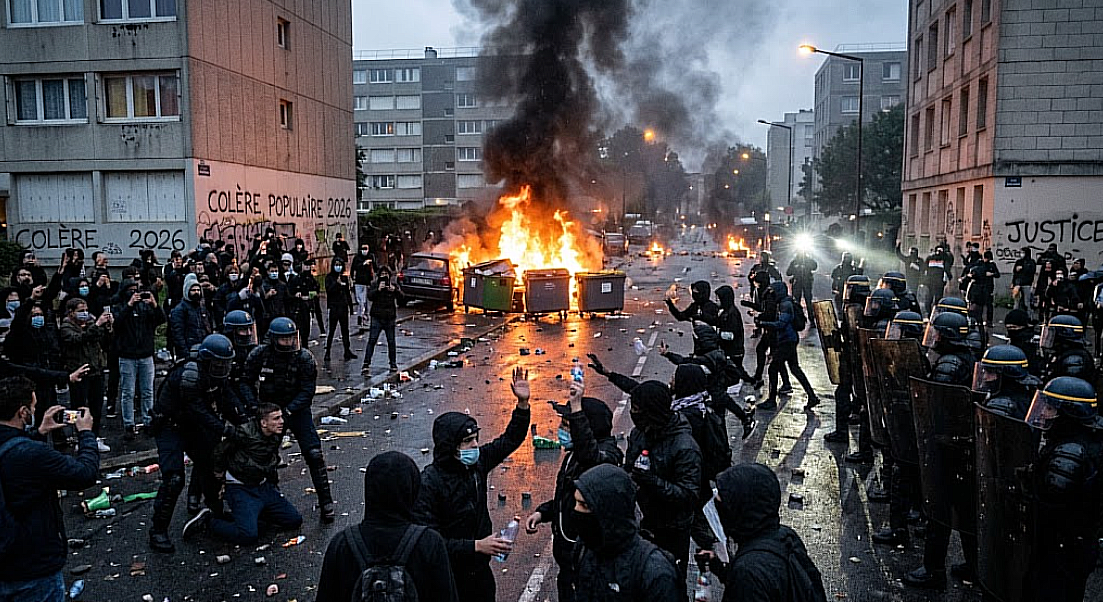
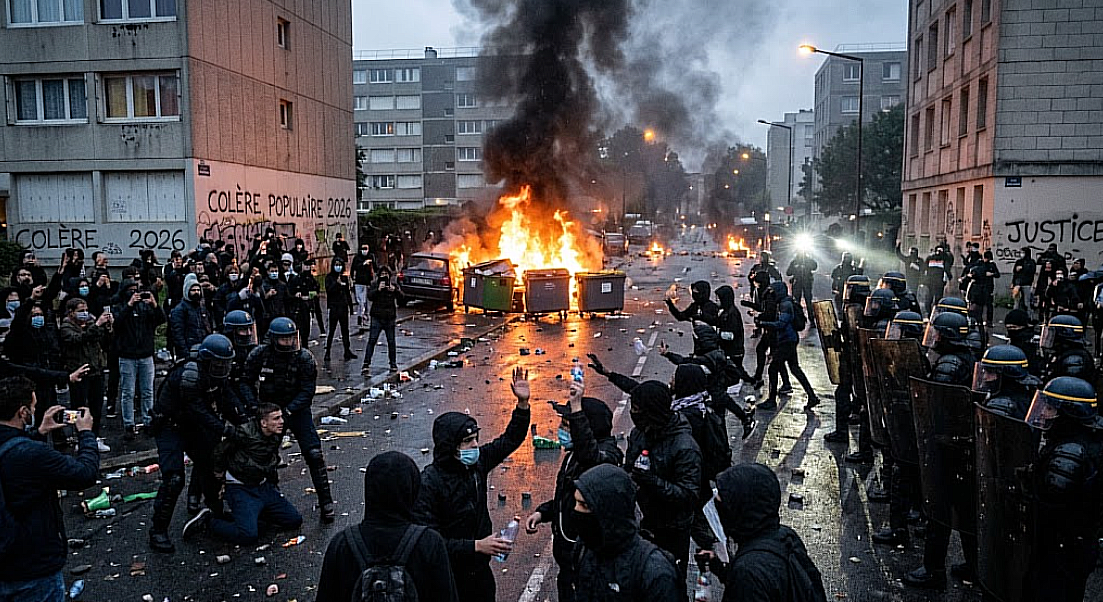
France is facing one of its most serious episodes of civil unrest in years after nationwide demonstrations over rising living costs, deteriorating public services, and student grievances escalated into violent confrontations, arson, looting, and widespread property damage and protests.
The events intensified on October 17, 2026, when demonstrators gathered across the country. While hundreds of thousands participated in peaceful marches, groups of violent protesters clashed with police, set vehicles on fire, attacked businesses, and targeted public buildings. In Limoges, a major fire devastated the historic town hall, turning the unrest into a national political and legal crisis.
Authorities reported approximately 2,400 arrests following the weekend's violence, alongside extensive damage to businesses and public infrastructure. Police used tear gas and water cannons to disperse some gatherings, while officials acknowledged failures in intelligence and police deployment. The government subsequently announced targeted curfews and preparations for a major security operation during further demonstrations.
The unrest has raised urgent questions about the right to protest, police powers, criminal responsibility, public safety, and the limits of government authority in a democratic society.
For President Emmanuel Macron's government, the challenge is twofold: restoring public order while addressing the grievances that brought people into the streets. For demonstrators, business owners, residents, and people facing arrest, the consequences extend beyond the immediate violence to potentially serious criminal proceedings and long-term financial losses.
This article examines what happened across France, why the protests escalated, how authorities responded, what the reported arrests mean legally, and which constitutional rights and criminal laws may shape the next stage of the crisis.
What Is Happening in France Right Now?
The latest unrest grew out of nationwide demonstrations against rising living costs and concerns about public services, with student grievances providing another major source of mobilization.
The protests brought together different groups with overlapping but not identical demands. Students raised concerns about conditions in schools and the state of education. Other demonstrators expressed anger over household expenses, fuel prices, and what they view as declining public services. Activists associated with the Yellow Vest movement also called for renewed protest activity.
The demonstrations were not uniformly violent. Many people marched peacefully, carrying flags, chanting slogans, and demanding political change. Violence erupted alongside some gatherings when groups attacked police, looted shops, damaged public property, and started fires.
That distinction matters. Participation in a peaceful demonstration is not equivalent to committing arson, assault, or theft. Criminal responsibility depends on an individual's conduct and the evidence against them, not simply on their presence in a crowd.
The scale of the unrest nevertheless placed enormous pressure on French authorities. Police and emergency services confronted simultaneous incidents in several cities, while local governments faced the destruction of public buildings and the disruption of ordinary services.
The government responded with additional security measures, localized curfews, and investigations intended to identify people suspected of participating in serious offenses. Officials also began examining why police deployments had failed to prevent some of the worst damage.
The political consequences may extend well beyond the streets. France is approaching its 2027 presidential election, making public order, living costs, immigration, policing, and government competence increasingly contentious political issues.
What Triggered the Protests?
There is no single explanation for the unrest. The demonstrations emerged from several sources of public dissatisfaction that converged during the October mobilization.
Rising living costs and economic pressure
Household expenses have become a central concern for protesters. Higher costs for essentials, including food, energy, and fuel, can place substantial pressure on families whose incomes have not kept pace.
For some demonstrators, the protests represent frustration with the government's economic priorities and its ability to protect ordinary households from financial pressure.
Economic dissatisfaction does not necessarily translate into support for violence. Many people take part in demonstrations because they believe conventional political channels have failed to deliver meaningful change.
However, large crowds can create opportunities for individuals or groups to engage in theft, vandalism, and attacks unrelated to the original demands.
Student grievances and public services
Student groups helped bring additional people into the streets. Concerns about school conditions and the quality or funding of education became part of the wider movement.
Public-service dissatisfaction can be particularly politically sensitive because it affects daily life directly. Families may be concerned about the resources available to schools, access to essential services, and whether public institutions can meet community needs.
The protests brought those issues together with economic complaints, allowing different groups to participate in the same demonstrations even when their specific demands differed.
The return of Yellow Vest activism
The Yellow Vest movement originally gained national prominence in 2018, particularly through protests over fuel taxation and broader complaints about economic fairness and political representation.
In October 2026, groups identifying with the movement called for renewed action amid rising fuel costs and dissatisfaction with government policy.
The movement's return adds a historical dimension to the current crisis. It recalls earlier episodes in which economic grievances developed into prolonged demonstrations, traffic disruptions, clashes with police, and pressure on the French government to change course.
Nevertheless, the 2026 protests should not automatically be treated as a direct continuation of the original Yellow Vest movement. The current demonstrations involve several constituencies and distinct political demands.
Political distrust and frustration
The unrest has also exposed broader dissatisfaction with the government. Some demonstrators believe their concerns about living standards and public services have not received an adequate response.
Political distrust can intensify when people believe that official statements do not reflect their everyday experiences. Conversely, violence and destruction can weaken public support for a protest movement, especially among people who agree with its economic demands but oppose attacks on businesses and public institutions.
The challenge for France is therefore not simply to identify who participated in the violence. It is also to understand how legitimate political grievances became entangled with destructive conduct.
Where Did the Worst Violence Occur?
The unrest affected multiple parts of France, from Paris and Marseille to Lyon, Limoges, and other urban centers. The nature and severity of the incidents varied by location.
Paris: Fires, looting, and clashes with police
Paris became one of the main centers of confrontation. During demonstrations around Place de la République and other areas, police used tear gas to disperse violent groups, while some protesters threw fireworks and other objects.
Vehicles and bicycles were set on fire, storefronts were damaged, and businesses were looted. Some groups targeted retail outlets and financial institutions, while police attempted to prevent crowds from reaching sensitive government locations.
The destruction disrupted transport and commercial activity. Some metro stations were closed at police request, and emergency services had to respond to fires and damaged property.
Paris also illustrated the difficulty of policing large demonstrations when peaceful participants and violent groups occupy the same general area.
Limoges: Historic town hall devastated by fire
Limoges suffered one of the most serious incidents of the weekend when its historic town hall was engulfed by fire.
Officials reported extensive destruction, including the collapse of the building's clock tower and severe damage to the historic section. The incident became a powerful symbol of the unrest because the building represents an important part of the city's civic heritage.
Authorities subsequently arrested a suspect in connection with the blaze. An arrest, however, is not proof of guilt; the allegations must be established through the criminal justice process.
The destruction raises several separate legal questions: whether arson can be proved, whether other people participated, what damage was caused, and what criminal penalties or compensation may be available if responsibility is established.
The loss also affects the wider community. Historic public buildings can carry cultural and administrative significance that extends far beyond the cost of repairing their physical structure.
Marseille: Municipal property targeted
In Marseille, protesters damaged businesses and briefly forced their way into the lobby of the city hall. Reports also described damage to municipal police property.
Attacks on government buildings can create additional security risks because such facilities may contain public records, administrative equipment, and spaces used to deliver essential services.
The legal consequences depend on what individuals actually did. Entering a building, damaging property, assaulting an officer, and setting a fire are distinct acts that may be charged under different provisions.
Lyon and other cities
Lyon also experienced unrest, including a fire inside a tourist office. Other locations reported damage to commercial premises, public infrastructure, and police property.
The geographical spread complicated the response because authorities had to manage multiple incidents while maintaining public safety elsewhere.
The available reporting establishes that the unrest extended beyond a single city. It does not mean that every French city experienced the same level of violence or that all demonstrations were unlawful.
How Many People Have Been Arrested?
French authorities reported approximately 2,400 arrests following the weekend's unrest, according to reporting published on October 18. The figure reflects the scale of the police response and the number of people detained in connection with incidents across the country.
However, the number of arrests must be understood carefully.
An arrest is an investigative step. It does not automatically mean that a person has been formally charged, prosecuted, convicted, or sentenced.
Some people who are arrested may be released without charges. Others may face prosecution if investigators believe sufficient evidence supports an offense. A case can also be discontinued or result in acquittal if the legal requirements are not met.
The final outcomes may therefore differ substantially from the initial arrest totals.
What happens after an arrest in France?
French criminal procedure provides several stages through which a suspected offense may be investigated and prosecuted.
Depending on the circumstances, an individual may be detained for questioning under garde à vue, the French procedure commonly translated as police custody. The applicable rules determine the permitted duration, extensions, access to legal assistance, and other safeguards.
Authorities may gather witness statements, review video footage, examine physical evidence, and investigate whether a suspect was involved in a particular act.
Following the investigation, prosecutors may decide whether to pursue charges, use an available alternative procedure, or discontinue the matter. More serious cases may proceed through additional judicial stages.
A person should not be considered guilty simply because their arrest appears in a news report or on social media.
The distinction is especially important during mass unrest, when people may be arrested in rapidly changing situations and investigators must determine what each individual actually did.
What Criminal Charges Could Protesters Face?
French law contains several offenses that may become relevant when demonstrations involve violence, fires, looting, or attacks on public property. The charge in any individual case depends on the facts, available evidence, and applicable statutory provisions.
Arson and intentional destruction by fire
Setting fire to a building or vehicle can expose a suspect to serious criminal liability. The applicable offense and penalty may depend on the nature of the property, the intention involved, whether people were endangered, and the resulting damage.
A fire that threatens occupants or emergency responders can create risks far beyond the financial loss associated with the property itself.
Investigators may examine surveillance footage, witness accounts, forensic evidence, and other information to establish who started a fire and whether the act was intentional.
The destruction of the Limoges town hall may therefore lead to significant criminal proceedings if prosecutors establish the relevant elements of an offense.
Property damage and vandalism
Breaking windows, damaging storefronts, destroying vehicles, and damaging municipal property may lead to criminal charges.
The precise legal classification can depend on whether the damage was intentional, the value and nature of the property, and whether aggravating circumstances apply.
Damage to public buildings may also create costs for local authorities and taxpayers, even when the immediate target is a particular institution.
Theft and looting
Removing merchandise from a shop without authorization may constitute theft under French law. A crowd setting may complicate an investigation, but it does not automatically excuse criminal conduct.
Authorities may use security footage, witness evidence, recovered property, and other records to identify suspects.
Prosecutors must still establish individual responsibility. A person who attended a demonstration cannot automatically be held responsible for theft committed by someone else.
Violence against police officers
Attacking police officers or other public officials can lead to criminal charges, with the potential consequences depending on the conduct, injuries, and circumstances.
Throwing objects at officers, assaulting them, or obstructing emergency responses can create serious public-safety risks.
Police conduct may also be investigated where allegations arise that officers used unlawful force. Accountability is not necessarily one-sided: the legal system can examine alleged offenses by protesters as well as alleged misconduct by authorities.
Participation in group violence
Where a group engages in coordinated violence or property destruction, prosecutors may investigate whether particular individuals knowingly participated in an offense.
Mere presence at a demonstration is not equivalent to participation in a criminal act. Evidence must connect the accused to the conduct alleged under the applicable law.
That distinction is central to protecting individual rights during mass arrests.
Can Protesters Be Sent to Prison?
Potentially, yes. Certain offenses involving arson, serious violence, theft, and aggravated property destruction can carry imprisonment under French law.
But there is no single penalty for participating in a riot. Sentences depend on the specific offense, the evidence, the person's role, aggravating or mitigating circumstances, prior convictions where relevant, and the court's assessment under the applicable law.
An individual accused of damaging a storefront may face a different legal outcome from someone accused of deliberately setting fire to an occupied building or seriously injuring another person.
The court must consider the offense proved rather than treating the entire crowd as one defendant.
French criminal procedure also distinguishes between pretrial detention and a sentence imposed after conviction. A person held in custody during proceedings has not necessarily been convicted.
This matters when reading headlines about arrests and detention. The number of people taken into custody does not reveal how many will ultimately receive prison sentences.
Can Protesters Be Required to Pay for the Damage?
Criminal prosecution and financial liability are separate issues.
A person found responsible for damaging property may face criminal penalties and may also be ordered to compensate victims where the legal requirements are satisfied.
Victims may include shop owners, local authorities, property owners, and others who suffered a legally recognized loss. Depending on the case, compensation may cover repair costs, destroyed property, or other recoverable damage.
The amount and availability of compensation depend on evidence, causation, the applicable legal rules, and the outcome of proceedings.
The French government has also indicated that businesses affected by the unrest may receive support. Public assistance, insurance payments, and claims against individuals are different mechanisms, each with its own requirements.
A business should not assume that every loss will automatically be reimbursed by the government. Owners may need to document damage, notify insurers, preserve receipts, and follow the procedures that apply to their circumstances.
Likewise, a person should not be held financially responsible for all destruction in a neighborhood simply because they attended a demonstration. Liability requires an appropriate legal basis and evidence connecting the person to the loss.
What Emergency Powers Can the French Government Use?
French authorities have several legal tools available to manage serious threats to public order. Their use is subject to constitutional principles, legislation, and judicial review.
Localized curfews
The government has announced targeted curfews in areas affected by the unrest. These restrictions can limit movement during specified hours and may be directed at particular locations or categories of people, depending on the legal basis.
Officials have said the measures are intended to reduce the risk of further violence and protect residents, public property, and businesses.
Curfews must be assessed according to their scope, legal authority, duration, and proportionality. A restriction imposed to address a specific risk is not necessarily equivalent to a nationwide suspension of ordinary rights.
Restrictions on demonstrations
French authorities may impose certain restrictions on public gatherings where legal requirements are met and public-order risks justify intervention.
Such decisions can involve difficult judgments. Authorities must consider the risk of violence while respecting the freedom to assemble and express political opinions.
A government cannot treat every unpopular protest as criminal simply because it criticizes the administration. Restrictions must have a lawful basis and be assessed against applicable rights and safeguards.
Police deployment and crowd control
Police may use legally authorized measures to protect people, disperse violent gatherings, and arrest suspected offenders. Tear gas and other crowd-control methods can also raise questions about necessity, proportionality, warnings, and the risk of injury.
The legality of a particular use of force depends on the circumstances and the applicable rules. It cannot be determined solely from the fact that a protest became violent or that an officer was injured.
The government has acknowledged failures in its response to the October 17 unrest and has announced a review of police tactics and intelligence arrangements.
Why the government did not declare a state of emergency
President Macron did not declare a nationwide state of emergency in response to the weekend's violence, despite calls from some political figures for a tougher response.
That decision matters because emergency frameworks can grant authorities additional powers under specified conditions. The precise powers available depend on the legal regime invoked and its statutory requirements.
The absence of a declared state of emergency does not mean authorities lack the power to arrest suspects, enforce ordinary criminal law, or impose lawful local restrictions.
It means that the government's response must be understood through the measures actually adopted rather than assumptions that extraordinary nationwide powers have been activated.
Did Police Lose Control of the Situation?
The government's response has come under significant criticism.
Prime Minister Sébastien Lecornu acknowledged failures in intelligence and police deployment. Interior Minister Laurent Nuñez also expressed regret over shortcomings in the response.
Officials said the security operation had been too static in some places and that decisions about police staffing and leave had contributed to the difficulties.
These admissions raise questions about whether authorities adequately anticipated the scale and geographical spread of the demonstrations.
At the same time, evaluating the police response requires more than looking at the damage after the event. Investigators and policymakers may need to examine the information available before the protests, the number of officers deployed, the speed of incidents, communications between agencies, and the decisions made as violence developed.
The government has announced a major security operation for subsequent demonstrations, including the planned deployment of military personnel alongside police. The precise role of each service and the applicable legal framework matter when assessing how the operation will work.
Police accountability is also a separate issue from the prosecution of people accused of violence. Reports of serious injuries among protesters, including an injury involving a crowd-control grenade, have prompted scrutiny of police tactics.
Any allegation of unlawful force requires evidence and an appropriate investigation. Equally, the existence of such allegations does not automatically establish that every police action was unlawful.
The wider legal challenge is to protect public safety while ensuring that law-enforcement powers remain subject to oversight.
What Rights Do Peaceful Protesters Have in France?
The right to demonstrate is an important feature of French democratic life, protected through domestic legal principles and European human-rights protections.
Peaceful protest allows people to criticize government policies, demand economic reforms, support student movements, and express opposition to political decisions.
The fact that some participants commit crimes does not automatically erase the rights of everyone else in the crowd.
French authorities must distinguish, as far as the circumstances permit, between peaceful demonstrators and individuals engaged in violence or property destruction.
The European Convention on Human Rights protects freedom of expression under Article 10 and freedom of assembly and association under Article 11. These rights are not unlimited, but restrictions must satisfy the relevant legal requirements, including lawful authority and necessity in a democratic society.
Public authorities may intervene to prevent violence and protect other people's rights. However, an overly broad restriction that treats peaceful political participation as equivalent to rioting can raise serious legal concerns.
For individuals arrested during demonstrations, the right to challenge the lawfulness of detention and to receive a fair determination of criminal allegations remains important.
The legal system must therefore address two concerns at once: ensuring accountability for serious offenses and protecting people who exercise their lawful rights.
How Could the Unrest Affect France's Economy and Politics?
The destruction has consequences beyond the immediate security response.
Businesses may lose merchandise, suffer broken windows and damaged equipment, close temporarily, or face higher security costs. Workers may lose shifts, while customers may avoid affected shopping areas.
Carrefour reported substantial losses associated with damaged and looted stores, illustrating how unrest can affect major retailers as well as small businesses.
Local authorities may face significant repair bills when public buildings, street furniture, and municipal facilities are damaged. The destruction of a historic town hall also creates a cultural loss that cannot necessarily be measured by construction costs alone.
The unrest has also contributed to political uncertainty. With the 2027 presidential election approaching, competing parties are using the events to argue for different responses involving security, immigration, economic policy, and public services.
Some political figures have called for tougher law-enforcement measures. Others have emphasized the grievances behind the demonstrations and the need to address the economic and social conditions that contributed to public anger.
The long-term political effect remains uncertain. Violence may increase demand for stronger public-order policies, but a government perceived as unable to address household pressures may also face further opposition.
The government's challenge is to restore confidence without treating every protester as a criminal or ignoring the concerns of communities that participated peacefully.
What Happens Next?
Several developments are likely to shape the coming days and weeks.
First, police and investigators will continue identifying suspects and examining evidence related to arson, looting, attacks on officers, and damage to public buildings.
Second, prosecutors will determine which cases should proceed and what charges are supported by the evidence. Arrest totals may change as individuals are released, charged, or brought before courts.
Third, the government is preparing a major security operation for further demonstrations, while localized curfews and other restrictions may remain in place where authorities consider them necessary.
Fourth, a parliamentary inquiry is expected to examine the causes of the unrest and shortcomings in the state's response. Its findings could influence police deployment, intelligence sharing, crowd-control policies, and government accountability.
Finally, student organizations and Yellow Vest activists have indicated that further demonstrations are possible. Their future actions will help determine whether the crisis subsides or develops into a more prolonged period of confrontation.
The situation remains fluid. Details about arrests, injuries, property damage, restrictions, and court proceedings may change as official information becomes available.
Readers should therefore distinguish confirmed developments from early estimates and claims circulating on social media.
Conclusions
France's October 2026 unrest has exposed the difficult intersection of economic dissatisfaction, public protest, policing, criminal responsibility, and political accountability.
Demonstrations over living costs, student grievances, and public services drew hundreds of thousands of people into the streets. Alongside those peaceful marches, violent groups set vehicles on fire, looted shops, attacked public buildings, and clashed with police. The destruction of Limoges' historic town hall became one of the most striking examples of the damage.
Authorities reported approximately 2,400 arrests and widespread losses, while the government acknowledged shortcomings in its handling of the crisis. Targeted curfews, expanded security preparations, and investigations into the violence followed.
The legal consequences will depend on the evidence and the conduct attributed to each individual. People accused of arson, theft, assault, or property destruction may face serious penalties if convicted, but an arrest is not proof of guilt. Likewise, peaceful demonstrators retain legal protections even when violence occurs nearby.
The government's task is not merely to restore order. It must also investigate failures, protect businesses and residents, respect constitutional rights, and address the economic and public-service concerns that helped mobilize the demonstrations.
The coming court proceedings, official inquiries, and further protests will determine whether France moves toward stabilization or experiences another round of serious unrest.
For readers seeking additional legal analysis and practical guides on public affairs, consumer issues, and everyday decisions, explore Jurnza, Finiuo, and Dryzen Royal.