

iPhone 18 Pro Max Price Hike: Is It Still Worth Buying in 2026?
Apple knows how to make a new iPhone feel like an event. The polished product videos, the carefully staged launch, the promises of better cameras, faster performance, smarter software, and longer battery life all help create the impression that the newest Pro model is something special. And to be fair, the iPhone 18 Pro and iPhone 18 Pro Max bring meaningful improvements to Apple's premium smartphone lineup.
But there is a question Apple fans should ask before upgrading: Does the iPhone 18 Pro Max actually justify its higher price, or are buyers paying more simply because Apple has released another generation?
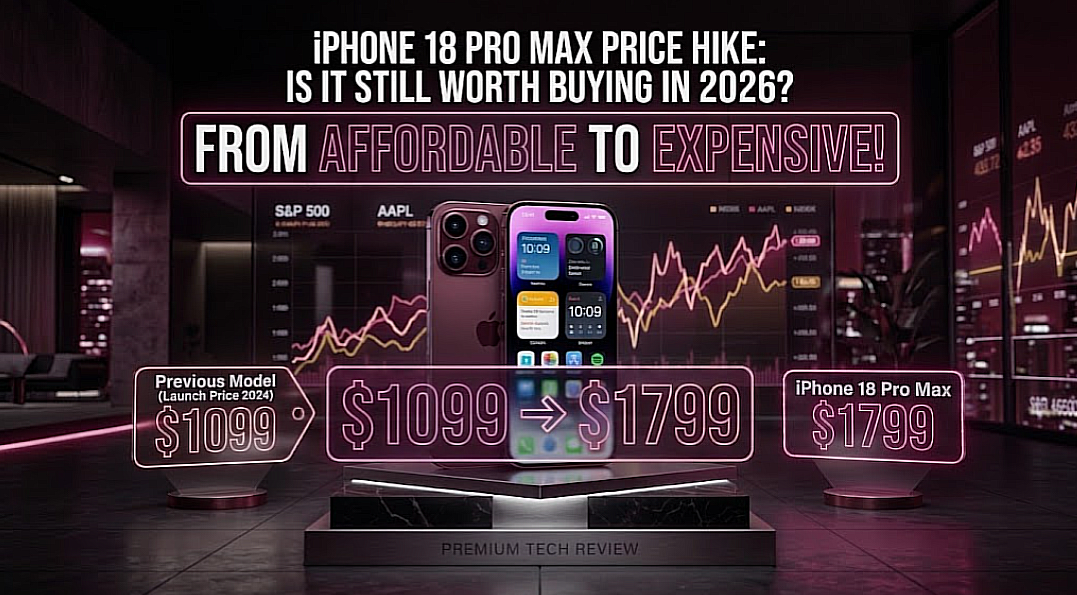
The iPhone 18 Pro starts at $1,199 in the United States, while the iPhone 18 Pro Max starts at $1,299. That is $100 more than the equivalent starting prices for the iPhone 17 Pro generation. The Pro Max remains a premium device, but its price makes the decision harder to justify for people who already own a recent flagship phone.
And here's where the competition gets interesting. Samsung's Galaxy S26 Ultra offers a direct alternative for buyers who want a large, powerful smartphone with advanced cameras and productivity features. The Galaxy Z Fold8 takes a different approach, giving users a foldable screen and a more tablet-like experience in a pocketable device. Depending on current promotions, storage configuration, and personal priorities, either could make more sense than the most expensive iPhone.
This is not an argument that the iPhone 18 Pro Max is a bad phone. It is an argument that an expensive phone should have to earn its price. A premium logo, a powerful processor, and a polished marketing campaign are not enough on their own.
For buyers spending more than a thousand dollars, the real question is simple: Is the iPhone 18 Pro Max the best use of your money in 2026, or would a Samsung flagship give you more of what you actually need?
1. The $100 Price Increase Is Harder to Ignore
The iPhone 18 Pro Max starts at $1,299 in the United States, compared with $1,199 for the previous generation's equivalent Pro Max configuration. The smaller iPhone 18 Pro also starts $100 higher, at $1,199.
A $100 increase might not seem enormous when viewed against a four-figure purchase. But that is exactly how expensive upgrades can become normalized. Buyers are encouraged to treat each additional charge as a small premium rather than asking whether the product delivers enough extra value to justify the total cost.
One hundred dollars could pay for a quality pair of headphones, a protective case and charger, a smartwatch contribution, or a portion of another useful purchase. It could also remain in your account instead of disappearing into a device that may not feel dramatically different from the phone you already own.
The issue is not that Apple is forbidden from raising prices. Components cost money, product development is expensive, and market conditions change. The issue is whether customers receive enough additional value to make the increase worthwhile.
Apple has introduced upgrades to the camera system, performance, battery life, and software experience. Those improvements matter, particularly to people who regularly shoot video, play demanding games, or rely on their phones for creative work. But a buyer who mostly messages friends, scrolls through social media, watches videos, and takes casual photographs may struggle to notice a difference proportionate to the price increase.
That is the uncomfortable part of buying a premium smartphone: the price rises for everyone, while the practical benefits vary enormously from person to person.
Before purchasing the iPhone 18 Pro Max, ask yourself whether the improvements solve an actual problem you have. If your current iPhone already performs smoothly, takes excellent pictures, and lasts through your day, upgrading may be more about wanting the newest model than needing it.
And wanting a new phone is perfectly fine. Just do not confuse that feeling with financial value.
2. Apple's Upgrades Sound Impressive, but Do You Need Them?
Apple's annual launch language tends to emphasize major advances. Each generation arrives with claims about improved performance, camera capabilities, battery life, and a better overall experience. The iPhone 18 Pro family follows that familiar formula, with a variable-aperture main camera, an A20 Pro chip, and other hardware and software changes.
These are genuine features, not meaningless additions. The question is how much they matter to the average buyer.
A faster processor is not automatically a reason to upgrade
The A20 Pro chip is designed to deliver stronger performance and support demanding tasks. That can benefit users who edit video on their phones, run intensive games, use advanced creative applications, or want more headroom for future software.
However, smartphone performance has reached a point where many everyday activities are already smooth on recent high-end devices. Messaging, browsing, streaming, navigation, and ordinary productivity do not necessarily become life-changing because an application opens slightly faster.
If your current phone is responsive and reliable, benchmark improvements alone should not persuade you to spend $1,299.
The more important questions are whether your existing device is slowing down, whether a particular application genuinely needs more power, and whether the new model delivers a noticeable improvement in your daily routine.
A better camera does not guarantee better value
The iPhone 18 Pro generation introduces a 48-megapixel main camera with variable aperture, giving photographers more control over how the camera handles light and depth of field. For enthusiasts, that is a potentially useful improvement.
But the distinction between a better camera system and a necessary camera upgrade matters.
If you regularly create professional content, record demanding video projects, or enjoy controlling photographic settings, the new capabilities may justify the expense. If most of your pictures are quick portraits, meals, holidays, and everyday moments, your existing flagship may already produce excellent results.
A camera upgrade should be evaluated according to the photographs and videos you actually make—not only the most impressive demonstration shown during a product launch.
Samsung also competes aggressively in premium photography, offering its own camera hardware and processing tools. That means buyers should compare actual photo and video samples, zoom performance, low-light results, skin tones, stabilization, and consistency rather than assuming the more expensive iPhone must be superior.
More battery life is useful, but calculate the benefit
Apple promotes substantial battery-life improvements for the iPhone 18 Pro lineup, especially the Pro Max. Longer battery life can be a meaningful advantage for frequent travelers, heavy users, and people who spend long hours away from chargers.
Yet battery life is also one of the easiest areas to overpay for when your current device already lasts comfortably through the day.
If your existing phone needs charging before dinner, a meaningful improvement could be worth a premium. If you finish most days with plenty of battery remaining, the extra endurance may have limited practical value.
The iPhone 18 Pro Max could be a strong choice for someone who genuinely needs its combination of performance, screen size, and battery capacity. That still does not make it the automatic best purchase for everyone.
3. The Pro Max Problem: Are You Paying for More Phone Than You Need?
The Pro Max is designed for buyers who want Apple's largest premium smartphone experience. A large screen is excellent for watching films, reading documents, editing content, viewing photographs, and playing games. A larger device can also accommodate a larger battery.
But bigger is not always better.
Large smartphones are harder to use one-handed, occupy more space in pockets, and can feel uncomfortable during extended use. Their weight and dimensions matter when you carry the phone throughout the day, use it while walking, or hold it for long periods.
The price difference between the standard Pro and Pro Max also deserves attention. If your main reason for choosing the larger model is its screen, consider how often you use your phone for activities that genuinely benefit from the extra space.
Someone who watches hours of video, edits content, or needs extended battery life may appreciate the Pro Max every day. Someone who mostly checks messages and social apps might get almost the same practical value from the smaller Pro.
There is also an opportunity-cost question. Would the money saved by choosing the smaller model improve your overall setup more than the larger display would? Perhaps you could buy better headphones, a power bank, additional storage elsewhere, or simply avoid stretching your budget.
The Pro Max is not a mistake by definition. The mistake is assuming the largest iPhone must be the best iPhone for your lifestyle.
4. Apple's Ecosystem Is an Advantage—and a Lock-In Risk
One of Apple's strongest arguments is its ecosystem. If you already own a Mac, iPad, Apple Watch, and AirPods, the iPhone can fit neatly into a connected setup. Features such as device continuity, shared services, and familiar interfaces can make switching less appealing.
That convenience has genuine value. It can save time, reduce friction, and make everyday tasks easier.
But the same ecosystem can also make buyers less willing to compare alternatives. When your digital life is tied to one manufacturer, switching feels like a much bigger project than replacing a phone. That can make it tempting to buy the next iPhone without seriously evaluating the competition.
Before paying a premium, identify which Apple services and features you actually use. Do you rely on an Apple Watch every day? Does your Mac workflow depend on continuity features? Are your family members using services that make remaining in the ecosystem especially convenient?
If the answer is yes, the cost of switching may be substantial. Staying with Apple could be the rational choice even if another phone offers stronger hardware in a particular category.
If your use of the ecosystem is limited to an iPhone and a few apps, however, the barriers may be much lower than you think. Many popular services work across iOS and Android, although moving messages, photographs, passwords, paid applications, and device-specific data still requires planning.
The important point is not that Apple's ecosystem is bad. It is that convenience should be part of your value calculation, not a reason to stop comparing prices and capabilities.
5. Samsung Galaxy S26 Ultra: The Most Direct Alternative
For buyers who want a traditional premium smartphone rather than a foldable, the Samsung Galaxy S26 Ultra deserves a place at the top of the comparison list.
Samsung's flagship targets many of the same customers as the iPhone 18 Pro Max: people who want a large display, powerful hardware, advanced cameras, and a device capable of handling demanding everyday tasks. But Samsung offers a different set of strengths, particularly for users who value customization and productivity features.
The S Pen adds a capability Apple does not match in the same way
One of the Galaxy S26 Ultra's defining advantages is its built-in S Pen. It can be useful for handwritten notes, annotating documents, signing files, sketching, and making precise selections on the screen.
That will not matter to every buyer. If you never write or draw on your phone, the S Pen may be an occasional novelty rather than a decisive advantage.
But for students, professionals, and people who regularly work with documents, having a stylus available without carrying a separate accessory can be genuinely useful. It gives the Samsung device a productivity angle that goes beyond processor speed or camera specifications.
Customization gives users more control
Samsung's Android software generally gives users more freedom to customize the home screen, organize applications, adjust supported system behaviors, and choose from a broader range of device and accessory options.
For people who enjoy tailoring their phones to their routines, that flexibility can make the device feel more personal. Users can choose layouts and workflows that suit them instead of adapting everything to Apple's preferred approach.
Of course, customization is not automatically a benefit. Some buyers prefer Apple's more consistent interface and do not want to spend time adjusting settings. The right choice depends on whether you value control or simplicity more.
Compare real prices, not just launch prices
At launch, the Galaxy S26 Ultra started at $1,299.99 in the United States, placing it close to the iPhone 18 Pro Max's $1,299 starting price. Samsung's U.S. pricing subsequently changed, and retailers may offer discounts that alter the comparison.
This is where buyers need to be careful. A listed retail price, a temporary sale price, and a carrier promotion are three different things. Trade-in credits may require an eligible device, a specific service plan, or a multi-year commitment.
Compare the amount you will actually pay for the same storage capacity, including taxes, accessories, and any conditions attached to a promotion. If the Samsung is cheaper after those adjustments, the savings can strengthen its case. If both cost roughly the same, decide based on the features you will use.
The Galaxy S26 Ultra is not automatically better than the iPhone. But if you want an S Pen, more customization, and a different approach to multitasking, Apple should not get your money by default.
6. Galaxy Z Fold8: Why Buy Another Slab When You Could Buy a Different Experience?
The Galaxy Z Fold8 is a more unconventional alternative. Rather than competing only on the familiar formula of screen, camera, and processor improvements, it offers a foldable design that opens into a larger display.
That changes how you can use a phone.
With the larger internal screen, compatible apps can provide more room for documents, reading, multitasking, browsing, and entertainment. Running supported applications side by side can make it easier to reference information while writing, compare documents, or keep a communication app open alongside another task.
For people who regularly work on the move, that larger workspace may be more useful than another incremental improvement to a conventional smartphone.
A foldable is not the right answer for everyone
The Z Fold8 also involves compromises. Foldable phones have more complex moving hardware, and buyers should carefully examine durability information, warranty coverage, repair costs, weight, and the feel of the cover screen before purchasing.
Some applications also work better on a conventional phone than on a larger, folding display. If you rarely multitask or prefer a lightweight device that is easy to use with one hand, the Fold8's central feature may not justify its cost.
Its price also requires a realistic comparison. Foldables can occupy a higher price tier than conventional flagships, so it would be misleading to claim that the Z Fold8 is always cheaper than the iPhone 18 Pro Max. Its value lies in the different experience it offers, with actual pricing dependent on storage, market, and current deals.
If you have been wishing your phone could double as a small tablet, the Fold8 may be more compelling than spending another year buying a traditional slab. If you just want a dependable camera and a familiar phone experience, the Galaxy S26 Ultra is the more direct Samsung comparison.
7. The iPhone 18 Pro Max Is Not Automatically the Better Camera Phone
Camera comparisons are often reduced to a single winner, but that approach can hide the differences that matter most.
Apple has built a strong reputation for consistent image processing and video capture. The iPhone 18 Pro Max's variable-aperture main camera adds creative control, and its camera system will appeal to people who like Apple's photo and video workflow.
Samsung, meanwhile, competes with its own flagship camera hardware, zoom capabilities, image-processing choices, and editing features. Different people may prefer different results. One phone's color rendering may look more natural to one photographer and less appealing to another.
The sensible comparison is to examine the kinds of images you take most often:
- Portraits: Compare skin tones, edge detection, background separation, and performance in difficult lighting.
- Zoom photography: Check how much useful detail each device preserves at the focal lengths you actually use.
- Night scenes: Compare motion handling, highlights, shadows, and the appearance of artificial lighting.
- Video: Look at stabilization, autofocus transitions, audio, exposure changes, and recording options.
- Social media: Check how the apps you use capture and upload content on each platform.
Do not rely solely on heavily edited promotional samples. Look for independent comparisons using the same scenes and settings, and distinguish native camera performance from images that have been edited afterward.
The bigger question is whether your current phone's camera is actually holding you back. If it already produces photographs you love, paying $1,299 for another excellent camera may be an expensive way to solve a problem you do not have.
8. Apple's AI Promises Should Not Be a Blank Cheque
Artificial intelligence has become a major selling point for premium smartphones. Apple is positioning the iPhone 18 Pro lineup around Apple Intelligence and a more capable Siri experience, while Samsung promotes Galaxy AI and related tools across its flagship range.
These features may become more useful as software develops. Writing assistance, summarization, image editing, contextual help, and other AI-powered tasks can make a phone more convenient when they work well.
But buyers should evaluate what is available now rather than paying a premium for an imagined future.
AI features can vary by language, region, application, account requirements, and software version. Some functions may rely on cloud processing, while others operate on the device. A feature demonstrated at a launch may not be available in every market or may require later software updates.
That matters particularly for international buyers. Before spending flagship money, confirm that the specific AI features you care about are supported in your country and preferred language.
The same standard should apply to Samsung. Galaxy AI may provide useful tools, but its presence on a specification sheet does not prove that it is more valuable than Apple's offering for every user.
Ask three questions: Which features can I use today? How often will I use them? Would I still buy this phone if the AI features were not included?
If the final answer is no, you may be paying too much for potential rather than proven usefulness.
9. The Hidden Cost of Owning a Premium iPhone
The advertised price is only the beginning of the ownership calculation.
A protective case, screen protector, charging accessories, repairs, and insurance can increase the total cost. Buyers who choose a higher storage tier will pay more upfront, while people who damage their phones may face expensive repair bills depending on the issue and their coverage.
This is not unique to Apple. Samsung's premium phones can also be expensive to repair, and foldable models deserve particular scrutiny because of their more complex construction.
The useful comparison is the total cost of ownership over the time you plan to keep the phone.
Suppose you expect to keep your next device for four years. A phone that costs more upfront may still be worth it if you use its special features every day, receive the software support you need, and can sell it later for a strong resale price. A cheaper phone may be the better deal if it meets your needs just as well.
Resale value also depends on storage, condition, local demand, warranty status, and the timing of your sale. Neither Apple nor Samsung should be assumed to win in every market and at every point in time.
For buyers in Pakistan, there is another practical consideration: the difference between an official local unit and an imported device. Local warranty coverage, PTA approval and applicable taxes, network compatibility, and the seller's reputation can materially change the true cost of ownership. A low advertised price is not necessarily a bargain if the phone comes with unresolved registration costs or weak after-sales support.
Before purchasing either flagship, obtain the complete local price and verify its status. A U.S. price comparison is a useful starting point, not a substitute for checking what the device will actually cost you.
10. Who Should Skip the iPhone 18 Pro Max?
The iPhone 18 Pro Max is a poor fit for several types of buyers—not because the device is inherently bad, but because its premium price may not deliver enough extra value for them.
People who already own a recent Pro iPhone
If your current phone runs smoothly, has a healthy battery, and takes photographs you are happy with, there may be little urgency to upgrade. A new model's advantages are easier to appreciate when replacing a struggling device than when replacing a perfectly capable one.
People who rarely use advanced features
If you do not edit video, play demanding games, use professional camera controls, or depend on intensive mobile workflows, you may not benefit much from the newest hardware. A less expensive iPhone or Android flagship could handle your routine comfortably.
Buyers who want more control over their phone
If you prefer extensive customization, stylus input, and more flexible multitasking, the Galaxy S26 Ultra may better fit your habits. The choice should be based on your preferred workflow rather than brand loyalty.
People who want a larger workspace
If your frustration with smartphones is the limited screen space, the Galaxy Z Fold8 offers a fundamentally different experience. Its foldable design is not perfect for everyone, but it is a meaningful alternative to buying another conventional phone.
Anyone stretching their budget to afford it
A smartphone should not create financial pressure. If buying the Pro Max means taking on expensive financing, postponing essential purchases, or draining savings you need for other priorities, stepping down to a cheaper model is the sensible move.
There is no shame in buying a less expensive phone. The only real mistake is paying for capabilities you will rarely use because marketing has made them feel essential.
11. When the iPhone 18 Pro Max Actually Makes Sense
A fair criticism should acknowledge where Apple's flagship earns its place.
The iPhone 18 Pro Max may be worth the money if you want a large premium display, need long battery life, value its camera and video workflow, and expect to use the device heavily for several years. Its combination of Apple's hardware, software, and ecosystem can be particularly attractive for people who already rely on a Mac, Apple Watch, or other Apple products.
It can also make sense for creators who need a capable mobile video tool, users who prioritize Apple's interface, or buyers whose work depends on specific iOS applications.
The key is to distinguish a considered purchase from an automatic upgrade. If the iPhone's strengths align closely with your needs, the price may be justified. If you are buying it because it is the newest and most expensive option, you should pause and compare alternatives first.
Consider the iPhone 18 Pro as well. If you want Apple's camera system and performance but do not need the larger display and battery, the smaller model may provide a more sensible balance. It is still expensive, but you avoid paying extra for a size that may not improve your daily experience.
You should also investigate trade-in offers and retailer promotions. Apple advertises trade-in and carrier incentives in the United States, but the headline discount is not the same as a universally available reduction. Read the eligibility rules, compare the total payments, and calculate the value of the phone you are giving up.
A good deal can change the decision. It should not remove the need to make one.
12. The Verdict: Apple Has to Earn the Extra Money
The iPhone 18 Pro Max is a premium smartphone with genuine strengths. Its camera system, performance, battery-life improvements, and integration with Apple's ecosystem give it a credible place in the flagship market.
But those strengths do not automatically justify a $1,299 starting price for every buyer, especially when the equivalent starting price has increased by $100.
Apple's biggest challenge is not proving that the iPhone 18 Pro Max is powerful. It is convincing customers that its improvements are worth paying for when recent iPhones remain capable and Samsung offers competitive premium devices with different advantages.
The Galaxy S26 Ultra deserves serious consideration for people who want an S Pen, extensive customization, and a traditional flagship form factor. The Galaxy Z Fold8 makes sense for buyers who want a larger workspace and a different approach to mobile multitasking. Neither is the universal winner, and current prices and promotions should be checked before deciding.
The smartest purchase depends on what you value. If you depend on iOS and Apple's ecosystem, the iPhone may still be the right answer. If you want more flexibility or a different form factor, Samsung could give you more useful features for your money. If your current phone already does everything you need, keeping it may be the best deal of all.
For more consumer-focused money decisions, readers can explore Finiuo. For legal and consumer-rights information, visit Jurnza, and for dry-fruit and nutrition content, explore Dryzen Royal.
The bottom line is simple: do not buy the iPhone 18 Pro Max just because Apple says it is the best iPhone yet. Buy it only if it is the best phone for your needs at a price you are comfortable paying. In 2026, Samsung's alternatives are too competitive—and the price of premium technology is too high—to make brand loyalty a substitute for comparison shopping.