

Why Your Paycheck Feels Smaller in 2026: Inflation, Wages, and the Real Cost of Living
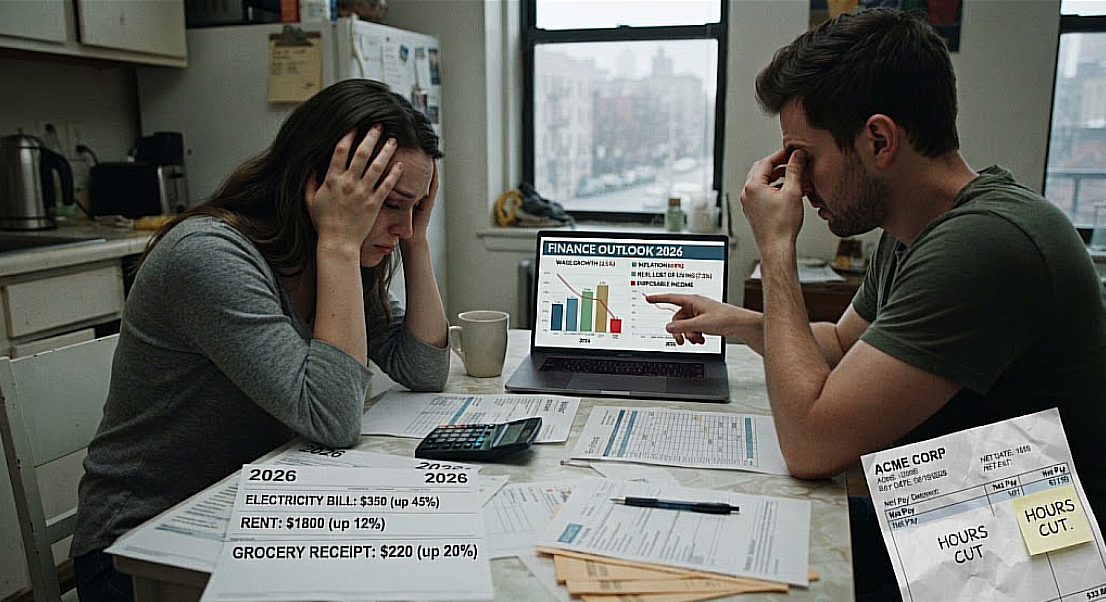
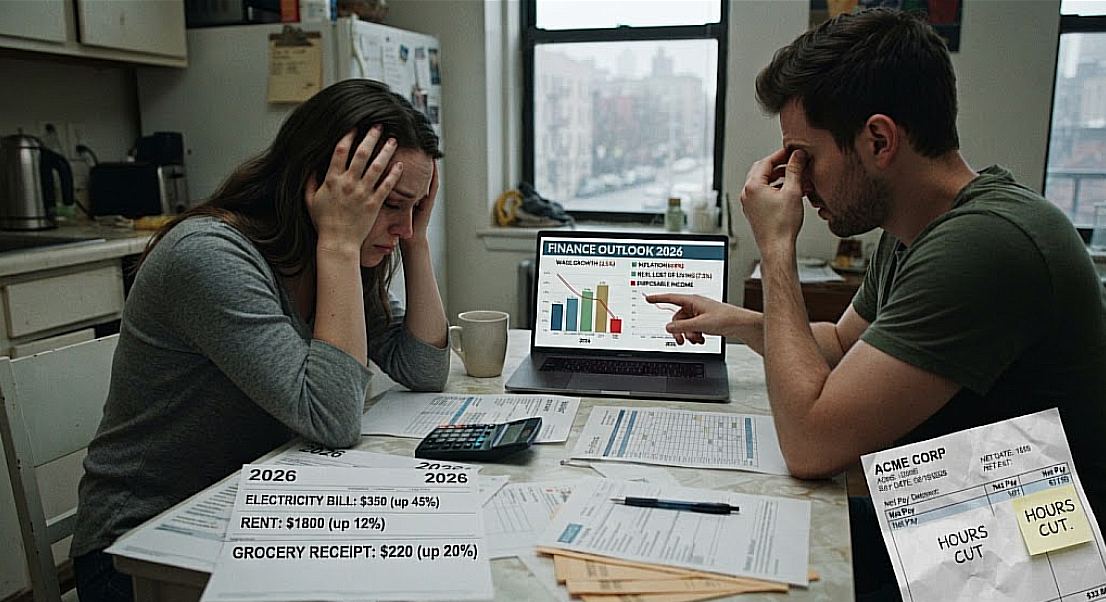
You got a raise. Your paycheck is technically bigger. And yet, somehow, it still feels like you're falling behind. That feeling is not necessarily your imagination. In the United States, consumer prices continued rising in 2026 even as wage growth continued. The problem is that what matters to a household is not simply whether wages are increasing. What matters is how quickly wages are increasing compared with the prices of the goods and services people actually need to buy.
The latest government data illustrate the tension.
The U.S. Bureau of Labor Statistics reported that consumer prices increased 3.4% over the 12 months ending in August 2026. At the same time, real average hourly earnings—wages adjusted for inflation—fell 0.3% from August 2025 to August 2026.
September employment data showed average hourly earnings for private-sector workers at $37.81, up 3.0% from a year earlier.
That creates an important personal-finance question:
If your salary is going up, why can your standard of living still feel like it is going down?
The answer lies in the difference between nominal income and real purchasing power.
A $60,000 salary today is not economically equivalent to a $60,000 salary several years ago if the prices of housing, food, transportation, insurance, healthcare, and other necessities have increased.
This guide explains why your paycheck can feel smaller even when your income is rising, how inflation affects purchasing power, why different households experience inflation differently, how to calculate your own personal inflation rate, and what you can do to protect your finances when prices continue rising.
The Number on Your Paycheck Is Not the Whole Story
Suppose your annual salary increases from $60,000 to $63,000.
That is a $3,000 raise.
Your income increased by 5%.
At first glance, that sounds good.
But imagine that the cost of the goods and services you regularly purchase increased by 6%.
You technically earn more money.
But your money buys less.
This is the basic concept behind real income.
Nominal income is the amount of money you receive.
Real income considers what that money can actually purchase.
The distinction is critical because people generally do not spend their income on abstract economic statistics. They spend it on:
- Housing
- Groceries
- Utilities
- Transportation
- Insurance
- Healthcare
- Childcare
- Education
- Debt payments
- Clothing
- Entertainment
- Travel
- Household goods
If those expenses rise faster than your income, your purchasing power can decline even though your paycheck increases.
Inflation Does Not Mean Prices Are Falling
One of the biggest misunderstandings about inflation is the idea that lower inflation means lower prices.
Usually, it does not.
Inflation measures the rate at which prices are increasing.
If inflation falls from 6% to 3%, prices are still generally increasing.
They are simply increasing more slowly.
Consider a simple example.
Imagine an item costs $100.
If its price rises 6%, it becomes $106.
If inflation then falls to 3%, the next year's price would rise from $106 to approximately $109.18.
The inflation rate went down.
But the price did not.
This is called disinflation.
Prices can continue rising even after inflation slows.
That distinction helps explain why households can feel financially squeezed even when economic headlines say inflation is “cooling.”
Inflation Is Still Rising in 2026
The latest available August 2026 CPI data show that consumer prices increased 3.4% over the previous 12 months. Prices excluding food and energy—the so-called core CPI—increased 2.4% over the same period.
The monthly increase also matters.
The CPI rose 0.4% in August on a seasonally adjusted basis.
A single month's movement does not determine the entire direction of the economy.
But it demonstrates why inflation can continue affecting household budgets even when the economy is no longer experiencing the much higher inflation rates seen earlier in the decade.
For consumers, the accumulated effect matters.
A price that is 20% or 30% higher than it was several years ago does not become inexpensive simply because the annual inflation rate has fallen.
Why Your Personal Inflation Rate May Be Higher Than the Headline Number
There is another important issue.
The official CPI represents the spending patterns of a broad population.
Your household does not necessarily spend money like the average household.
Imagine two households.
Household A
Household A:
- Owns a home
- Has no children
- Drives an older paid-off car
- Spends relatively little on healthcare
- Cooks at home
- Has inexpensive insurance
Household B
Household B:
- Rents an apartment
- Has two children
- Drives a newer vehicle
- Pays for childcare
- Has significant healthcare expenses
- Commutes long distances
- Has higher insurance costs
Both households live in the same country.
Both are affected by inflation.
But their personal inflation rates can be dramatically different.
If rent and childcare are rising quickly, Household B may feel substantially more financial pressure than Household A even if the national CPI is unchanged.
This is why personal-finance decisions should not rely solely on the headline inflation number.
Housing Can Change the Entire Equation
Housing is often one of the biggest expenses in a household budget.
For renters, increases in rent can quickly affect disposable income.
For homeowners, the situation can be more complicated.
A homeowner with a fixed-rate mortgage may have relatively stable principal-and-interest payments while facing increases in:
- Property taxes
- Home insurance
- Utilities
- Maintenance
- Repairs
- HOA fees
A renter may face rising monthly rent.
A prospective homebuyer may encounter another problem: higher mortgage rates can increase monthly payments even if home prices remain relatively stable.
This means the housing cost experienced by a household depends heavily on its situation.
Two people earning identical salaries can have completely different financial experiences because one locked in a low mortgage rate years ago while the other is currently renting or trying to buy.
Why a Raise Can Still Feel Like a Pay Cut
Let's use a simple example.
Suppose you earned:
$50,000
and received a 4% raise.
Your new salary would be:
$52,000
That sounds like an extra $2,000.
But suppose your household expenses increased by 5%.
Your purchasing power did not increase by 4%.
It actually declined relative to the previous year.
A rough way to think about real wage growth is:
Real wage growth ≈ wage growth − inflation
This is a simplified approximation rather than a substitute for an official real-wage calculation.
If wages rise 4% and prices rise 5%, purchasing power is roughly down 1%.
If wages rise 4% and prices rise 2%, purchasing power is roughly up 2%.
The relationship is simple:
Your financial position improves when your income grows faster than the prices you face.
What the Latest Wage Data Show
The current wage data make this issue particularly relevant.
In September 2026, average hourly earnings for private nonfarm employees increased by 5 cents to $37.81, according to the BLS. Over the previous 12 months, average hourly earnings increased 3.0%.
But the latest available BLS real-earnings report, covering August, showed that real average hourly earnings decreased 0.3% over the year. Real average weekly earnings increased 0.3% because the average workweek increased.
That distinction is important.
A person can earn more per hour while still experiencing little improvement—or even a decline—in inflation-adjusted hourly purchasing power.
Working more hours can increase weekly earnings even when the purchasing power of each hour is not improving.
A $5 Raise Is Not Necessarily a Real Raise
Imagine your employer increases your hourly wage from:
$25 to $26
That's a $1 increase.
Your wage rose 4%.
But suppose the prices of the things you buy rose by 5%.
The extra dollar does not necessarily make you financially better off.
This is why employees should look beyond the headline percentage of a raise.
Instead, consider:
Raise percentage − personal inflation rate
If you receive a 3% raise but your household expenses rise by 6%, your budget may become tighter.
If you receive a 6% raise while your expenses rise by 3%, you have more room.
The same salary increase can therefore feel completely different depending on what happens to your expenses.
Inflation Hits Fixed-Income Households Differently
Inflation can be especially difficult for people whose income does not automatically adjust with prices.
Consider someone receiving a fixed monthly payment.
If that payment remains unchanged while groceries, insurance, utilities, and healthcare costs increase, the person's purchasing power falls.
Retirees, people living on fixed benefits, and workers whose wages are rarely adjusted can be particularly sensitive to this effect.
But even workers receiving annual raises can experience the same problem if raises do not keep up with their household's actual expenses.
Why Groceries Feel So Expensive
Food is one of the most visible parts of household inflation.
You buy groceries repeatedly.
That makes even relatively small price increases noticeable.
If an item you buy every week rises from $4 to $4.50, you notice.
If ten different items rise by similar amounts, the effect becomes larger.
A household may therefore experience what feels like a constant stream of small price increases.
Over a year, those changes can add up to hundreds or thousands of dollars.
This is one reason tracking actual spending can be more useful than simply reading the national inflation rate.
Shrinkflation Can Make Inflation Harder to Notice
Not every price increase appears as a higher sticker price.
Sometimes the product becomes smaller.
For example, imagine a package that previously contained 16 ounces and now contains 14 ounces while the price remains unchanged.
The posted price did not increase.
But the price per ounce did.
This phenomenon is commonly called shrinkflation.
From a household-budget perspective, unit prices can therefore be more informative than package prices.
When comparing products, look at:
- Price per ounce
- Price per pound
- Price per unit
- Price per serving
- Quantity included
A product that appears cheaper may actually cost more per unit.
Services Can Also Quietly Raise Your Expenses
Inflation is not just about physical products.
Services can become more expensive too.
Examples include:
- Insurance
- Childcare
- Healthcare
- Education
- Repairs
- Home maintenance
- Professional services
- Subscription services
- Transportation
These expenses can be particularly frustrating because households cannot always reduce them easily.
You can decide to buy fewer snacks.
You cannot necessarily decide to stop paying for car insurance if you need the vehicle.
That is why household inflation is often more complicated than simply “shop cheaper.”
Insurance Can Create a Major Budget Problem
Insurance deserves special attention.
A household may experience a substantial increase in:
- Auto insurance premiums
- Homeowners insurance
- Renters insurance
- Health insurance
- Other coverage
Even if wages increase, a large insurance increase can consume much of the additional income.
For example, suppose your annual salary rises by $2,000 after a raise.
But your annual insurance expenses increase by $800.
Then your additional income available for other purposes is substantially smaller than the headline raise suggests.
This is why budgeting should focus on after-expense purchasing power, not just gross salary.
Why Debt Makes Inflation Feel Worse
Inflation can interact with debt in complicated ways.
A fixed-rate debt payment may become easier to manage over time if wages rise while the nominal payment remains unchanged.
But variable-rate debt can become more expensive when interest rates are high.
Credit-card balances are particularly dangerous because their interest rates can be high and the balance can persist when borrowers make only minimum payments.
Suppose you carry a $5,000 balance.
If your annual percentage rate is 24%, the interest cost can be substantial.
Even if inflation is making your everyday expenses more expensive, adding expensive revolving debt can make the situation significantly worse.
This is why an inflation-era budget should pay attention not only to prices but also to interest costs.
Why Your Savings May Feel Smaller Too
Inflation affects savings even when the dollar balance never changes.
Imagine you have:
$20,000
in a savings account.
If your account earns 1% while inflation is 3%, your money's purchasing power is declining even though the account balance increases slightly.
The relevant concept is the real interest rate.
A simplified approximation is:
Real return ≈ interest rate − inflation
So:
- Savings yield: 1%
- Inflation: 3%
- Approximate real return: −2%
If your savings account earns 4% while inflation is 3%, the approximate real return is positive 1%.
Taxes can also affect the after-tax result.
That is why savers should consider both the stated interest rate and the purchasing power of the money they are saving.
Inflation Can Hurt Cash Held for Too Long
Cash is useful.
You need liquid money for emergencies and short-term expenses.
But keeping all long-term savings in cash can create an inflation problem.
If prices rise over time while your cash earns little or no interest, the real value of those savings declines.
That does not mean every dollar should be invested in stocks or other risky assets.
The right balance depends on:
- Time horizon
- Emergency-fund needs
- Risk tolerance
- Financial goals
- Debt
- Investment options
- Tax situation
The key point is simply that cash has an inflation cost when it earns less than the rate at which prices rise.
How Inflation Affects Retirement Planning
Inflation can be particularly important for retirement.
Suppose you estimate that you need $50,000 per year to maintain your lifestyle today.
That does not mean you will need exactly $50,000 every year in retirement.
If prices continue rising, the future dollar amount required to purchase the same lifestyle can be much larger.
This is why retirement planning typically considers inflation assumptions.
For example, if a household spends $50,000 per year today and expenses increase at an average 3% rate for 20 years, the equivalent annual spending level would be roughly:
$50,000 × 1.03²⁰ ≈ $90,300
That does not mean inflation will actually average exactly 3% for the next 20 years.
It is an illustration of compounding.
Small annual increases can become substantial over long periods.
Why Inflation Compounds
Inflation compounds because each year's prices build on the previous year's prices.
Suppose an item costs $100.
At 3% annual inflation:
Year 1: $103
Year 2: $106.09
Year 3: $109.27
Year 5: approximately $115.93
Year 10: approximately $134.39
Year 20: approximately $180.61
That is why even moderate inflation can significantly affect long-term financial planning.
The same mathematics applies to salaries, although wage growth is not guaranteed to follow a fixed rate.
Your Personal Inflation Rate Is Worth Calculating
Instead of asking:
“What is inflation?”
you can ask:
“What is happening to the prices of the things I actually buy?”
A simple way to estimate your personal inflation rate is to compare your spending in two periods.
For example:
Expense | Year 1 | Year 2 |
|---|---|---|
Rent | $1,500 | $1,650 |
Groceries | $500 | $550 |
Utilities | $200 | $220 |
Transportation | $300 | $330 |
Insurance | $200 | $240 |
Other expenses | $800 | $850 |
Total | $3,500 | $3,840 |
Your spending increased by:
$340
Your percentage increase was:
$340 ÷ $3,500 × 100 ≈ 9.7%
That does not mean your personal inflation rate is exactly 9.7% in a statistical sense.
It means your tracked spending increased by approximately 9.7%.
That's a much more useful number for your own budget than a national average if your spending pattern is very different from the average household.
How to Calculate Your Break-Even Raise
You can also calculate how large a raise you need just to maintain purchasing power.
Suppose your salary is:
$70,000
and your relevant annual inflation rate is approximately:
4%
A rough break-even salary would be:
$70,000 × 1.04 = $72,800
So you would need approximately $72,800 simply to have the same inflation-adjusted purchasing power under that simplified assumption.
A salary of $71,000 would technically be higher.
But it would not fully compensate for 4% inflation.
A salary of $75,000 would represent a larger real increase.
What If You Get a 10% Raise?
A 10% raise sounds substantial.
Suppose your salary increases from:
$60,000 to $66,000
If your expenses rise by 3%, your purchasing power has improved.
But if you also experience major increases in housing, healthcare, childcare, insurance, or debt payments, the improvement may feel smaller than the headline number.
This demonstrates an important principle:
Real financial progress depends on both income and spending.
You cannot always control inflation.
But you can sometimes control the expenses that are most responsive to your choices.
The Biggest Budget Wins Usually Come From Large Expenses
If inflation is squeezing your finances, obsessing over tiny purchases may not be the most effective strategy.
Saving $5 per week is useful.
But reducing a $500 monthly expense can have a much larger effect.
Look first at major categories:
- Housing
- Transportation
- Insurance
- Debt interest
- Childcare
- Healthcare
- Food
- Subscriptions
- Travel
For example, reducing a $600 monthly car payment to $450 saves:
$150 × 12 = $1,800 per year
That may have a greater impact than cutting dozens of small discretionary purchases.
Housing: The Biggest Lever for Many Households
Housing can dominate a household budget.
If your rent is $2,000 per month, reducing housing costs by 5% would save approximately:
$100 per month
or:
$1,200 per year
A larger reduction can produce even more savings.
But moving is not free.
You need to consider:
- Moving expenses
- Security deposits
- Commuting costs
- Utility differences
- Rent increases
- Quality of life
- School districts
- Neighborhood
- Lease terms
The cheapest rent is not automatically the cheapest housing arrangement once all costs are considered.
Transportation Can Be Another Hidden Inflation Problem
Transportation costs include more than gasoline.
Consider:
- Car payment
- Insurance
- Fuel
- Maintenance
- Repairs
- Registration
- Parking
- Tolls
- Depreciation
A household can therefore reduce transportation costs by examining the entire ownership cost.
Sometimes keeping an older reliable vehicle is financially better than replacing it with a new vehicle and taking on a large loan.
But older vehicles can also produce higher maintenance costs.
The correct decision depends on the numbers.
How to Protect Your Budget From Rising Prices
You cannot completely eliminate inflation risk.
But you can make your finances more resilient.
Build an Emergency Fund
An emergency fund provides liquidity when unexpected expenses occur.
The appropriate amount varies by household.
A person with highly stable income and low expenses may need a different reserve from someone with variable income and substantial financial obligations.
Reduce High-Interest Debt
High-interest debt can overwhelm other financial improvements.
Paying down expensive revolving debt can effectively provide a guaranteed financial benefit equal to the interest you avoid, subject to the specific circumstances of the debt.
Review Recurring Expenses
Look at:
- Streaming services
- Phone plans
- Internet
- Insurance
- Memberships
- Software
- Subscriptions
Recurring expenses are easy to overlook because they happen automatically.
But small monthly charges can add up.
Increase Income
Expense reductions have limits.
Income growth can provide another path.
Potential options include:
- Asking for a raise
- Changing employers
- Developing a marketable skill
- Freelancing
- Starting a side business
- Increasing billable hours
- Pursuing certifications
A $5,000 annual income increase can have a significant impact if it is sustainable.
Save Automatically
Automatic transfers can help maintain savings even when everyday expenses increase.
If your income rises, consider directing part of the increase toward:
- Emergency savings
- Retirement
- Debt repayment
- Other financial goals
That prevents every raise from being absorbed by lifestyle inflation.
Watch Out for Lifestyle Inflation
Lifestyle inflation occurs when spending rises as income rises.
Suppose your salary increases by $5,000.
You could:
- Save $2,000
- Pay down $1,500 of debt
- Spend $1,500
Or you could immediately increase your lifestyle by the entire $5,000.
The second approach may feel good initially.
But it leaves you vulnerable if your income later falls.
A raise is an opportunity to improve your financial position, not just increase consumption.
Should You Ask for a Raise During Inflation?
Inflation can be relevant when discussing compensation, but an employer does not necessarily have an obligation to match inflation.
A useful approach is to focus on your market value and measurable contribution.
Consider:
- Increased responsibilities
- Performance results
- Revenue generated
- Costs reduced
- New skills
- Additional certifications
- Leadership
- Market salary data
Instead of simply saying:
“Everything costs more.”
you can make a stronger compensation case by showing:
“My responsibilities increased, my results improved, and comparable roles are paying more.”
Inflation can provide context, but your compensation conversation should generally include your value to the employer.
Why Salary Growth Does Not Always Equal Financial Progress
Imagine three workers.
Worker A
Salary: $60,000
Annual raise: 3%
Expense growth: 2%
Worker A's purchasing power is roughly improving.
Worker B
Salary: $60,000
Annual raise: 3%
Expense growth: 3%
Worker B is roughly maintaining purchasing power.
Worker C
Salary: $60,000
Annual raise: 3%
Expense growth: 6%
Worker C is losing purchasing power.
All three received the same raise.
Their financial outcomes are completely different.
This is why salary alone does not tell the whole story.
What About Investing During Inflation?
Inflation also affects investment decisions.
Different assets can respond differently to inflation, interest rates, economic growth, and market expectations.
For long-term investors, the key issue is whether their portfolio has a reasonable chance of producing returns that exceed inflation over the relevant time horizon.
But investments carry risk.
Stocks can decline.
Bonds can lose value when interest rates rise.
Real estate can decline or become illiquid.
Commodities can be volatile.
There is no universal investment that guarantees protection from inflation.
The appropriate strategy depends on the investor's goals, time horizon, risk tolerance, and broader financial situation.
Why Long-Term Investors Should Focus on Real Returns
Suppose an investment earns 8%.
That sounds impressive.
But if inflation is 5%, the approximate real return before taxes and fees is around 3%.
If inflation is 2%, the approximate real return is closer to 6%.
The headline investment return therefore does not tell the whole story.
A useful long-term question is:
How much purchasing power did my investment actually create?
Taxes Make the Difference Even More Important
Taxes can reduce the amount of your nominal income or investment return that you actually keep.
Suppose an investment earns 6%.
If inflation is 3% and taxes and fees reduce the effective return further, your real after-tax purchasing-power gain can be much smaller than 3%.
This is why financial planning should consider:
Nominal return → taxes → fees → inflation → real after-tax result
The exact calculation depends on the investment and tax situation.
What the Current Numbers Mean for Households
The latest U.S. data provide an interesting picture.
Inflation remains positive.
Average wages are still increasing.
But the latest BLS real-earnings data showed that real hourly earnings fell over the year through August.
At the same time, September employment data showed nominal average hourly earnings rising 3.0% over the prior year.
This combination explains why the economy can simultaneously produce headlines about wage growth and stories about households feeling financially squeezed.
Both can be true.
Workers can earn more dollars.
Yet those dollars can buy less.
The Psychological Side of Inflation
There is also a behavioral element.
People notice prices more easily than they notice gradual changes in purchasing power.
You might remember:
“Coffee used to cost $3.”
But you may not notice that dozens of recurring expenses increased slightly.
The result can feel like death by a thousand cuts.
That is why tracking your actual spending is powerful.
A budget turns a vague feeling—
“Everything is expensive.”
into specific information:
“Housing increased 7%, groceries increased 8%, insurance increased 15%, but entertainment spending fell 10%.”
Once you have numbers, you can make decisions.
A Simple Monthly Inflation Check
Once every three months, review your major expenses.
Create four columns:
Category | Previous Cost | Current Cost | Change |
|---|---|---|---|
Housing | $1,800 | $1,900 | +$100 |
Groceries | $500 | $560 | +$60 |
Insurance | $200 | $240 | +$40 |
Transportation | $350 | $380 | +$30 |
Utilities | $180 | $195 | +$15 |
Then calculate the total increase.
In this example, monthly expenses increased by:
$245
That equals:
$2,940 per year
Suddenly, the financial impact becomes much easier to understand.
A household may discover that it needs a larger raise than expected simply to maintain its existing lifestyle.
What If You Cannot Cut Your Expenses?
Not every household has flexible spending.
If your budget is already tight, cutting another $20 from entertainment may not solve the problem.
You may need to focus on structural changes.
That could include:
- Negotiating salary
- Finding cheaper housing
- Refinancing eligible debt
- Changing insurance providers
- Reducing transportation costs
- Increasing income
- Seeking employer benefits
- Consolidating certain expenses
- Applying for available assistance programs
The goal is not to eliminate every enjoyable expense.
It is to create enough financial margin that rising prices do not push the household into expensive debt.
The Bottom Line
A bigger paycheck does not automatically mean a better financial situation.
The real question is:
How much can your income buy after accounting for inflation and your actual household expenses?
As of the latest available data, U.S. consumer prices were up 3.4% over the year through August 2026, while real average hourly earnings declined 0.3% over that period. September nominal average hourly earnings were up 3.0% from a year earlier.
Those numbers do not mean every American is worse off.
Households experience inflation differently.
Some workers receive raises that exceed their expenses.
Some homeowners have fixed-rate mortgages.
Some consumers have reduced debt.
Others face rapidly rising rent, insurance, healthcare, childcare, or other costs.
That is why the most useful inflation number for your personal finances may be the one you calculate yourself.
Track what you actually spend.
Compare your income growth with your expense growth.
Look at real purchasing power rather than just the dollar amount on your paycheck.
Pay attention to high-interest debt.
Protect your emergency savings.
Review recurring expenses.
And when you receive a raise, consider using at least part of it to strengthen your financial position before allowing your lifestyle to expand.
Inflation may be measured nationally, but you experience it personally—one rent payment, grocery bill, insurance premium, and paycheck at a time.
Conclusions
The feeling that your paycheck is getting smaller can have a straightforward economic explanation.
Your paycheck can increase while your purchasing power decreases if the prices of the goods and services you buy rise faster than your income.
The latest U.S. data show why the distinction matters. Consumer prices increased 3.4% over the year through August 2026, while real average hourly earnings declined 0.3% over that same period. September nominal hourly earnings increased 3.0% over the previous year.
The solution is not to panic every time inflation moves higher.
Instead, understand the numbers.
Know your income.
Know your largest expenses.
Calculate how quickly those expenses are increasing.
Reduce costs where practical.
Increase income where possible.
Protect yourself from high-interest debt.
Keep an appropriate emergency reserve.
And consider the purchasing power of your money—not just the number printed on your paycheck.
A $3,000 raise can be meaningful.
But what ultimately matters is what that extra $3,000 can buy.
That is the difference between earning more money and actually becoming financially better off.