

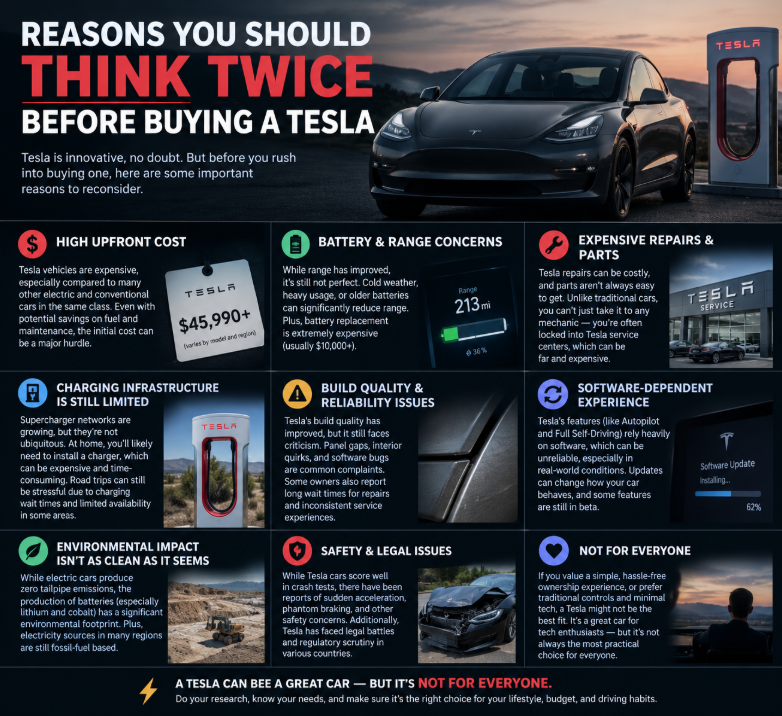
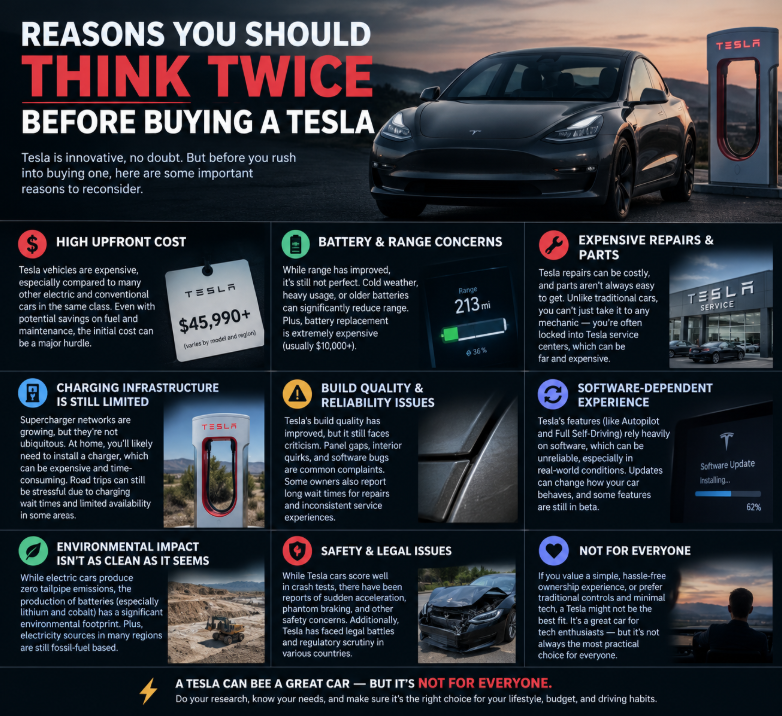
12 Reasons You Should Think Twice Before Buying a Tesla: The Downsides Nobody Talks About
Tesla has changed the electric-car market. Its vehicles offer quick acceleration, modern technology, over-the-air software updates, and access to a charging network that has helped make electric road trips more practical. For many drivers, those advantages are real.
But buying a Tesla is not just a decision about technology. It is a major financial commitment that can affect your insurance bill, repair expenses, resale value, daily routine, and long-term ownership costs.
The advertised price is only the beginning. Buyers also need to consider how much range they will actually get, whether charging fits their lifestyle, what happens after the warranty expires, and whether features marketed as advanced driving assistance meet their expectations.
Tesla is not automatically a bad purchase. Consumer Reports' 2026 brand rankings placed the company among the stronger brands for new-car reliability and owner satisfaction, while ranking it much lower for used-car reliability. That mixed picture is precisely why buyers should look beyond fan enthusiasm and online criticism alike.
Here are 12 reasons you may want to think twice before buying a Tesla in 2026, particularly if you are looking for predictable costs, convenient ownership, and a vehicle that suits your everyday needs.
1. The Real Cost of Ownership Can Be Higher Than You Expect
A Tesla can save some owners money on fuel and routine maintenance, but those savings do not automatically make it cheaper than a gasoline-powered car.
The purchase price is only one part of the calculation. You also need to account for insurance, registration, charging equipment, electricity, tires, repairs, depreciation, and financing costs where applicable.
For example, someone who charges at home using relatively inexpensive electricity may spend considerably less on energy than a driver who relies on gasoline. But a person who must use public fast chargers regularly may experience a smaller saving, depending on local electricity prices and driving habits.
Home charging also comes with practical considerations. You may need to install a suitable charging outlet or wall connector, pay for electrical work, or upgrade parts of your home's electrical system. The cost varies considerably depending on the property and existing equipment.
Then there is depreciation. A vehicle can lose value because of age, mileage, market conditions, newer technology, or changes in the prices of new models. If a manufacturer reduces the price of a new vehicle, comparable used vehicles can become less attractive to buyers.
That does not mean every Tesla depreciates faster than every competing vehicle. Depreciation depends on the model, purchase price, condition, mileage, local demand, and resale market. However, buyers should not assume that a technologically advanced car will necessarily hold its value.
Before signing a purchase agreement, estimate the total cost over the number of years you expect to own the vehicle. Include insurance quotes, charging expenses, maintenance, expected depreciation, and financing costs.
If the full calculation is substantially higher than the cost of a suitable alternative, the Tesla may not be the bargain its headline price suggests.
2. Insurance Can Eat Into Your Charging Savings
One of the biggest attractions of an electric vehicle is the potential to spend less on energy. But what you save at the charging station can be offset by higher insurance premiums.
Insurance prices depend on several factors, including the driver's age, driving record, location, coverage limits, vehicle value, repair costs, and claims history. Some Tesla models may cost more to insure than comparable vehicles because of their value, performance, parts, or repair requirements.
There is no single insurance price that applies to every Tesla owner. Two drivers with the same model can receive very different quotes.
This is why checking insurance after purchasing a vehicle is a mistake. By that point, you may already have committed to a payment that is difficult to change.
Get quotes before buying. Compare the same coverage limits and deductibles across several insurers, and make sure the quotes refer to the exact model and trim you want.
For a fair comparison, calculate the annual premium and multiply it by the expected ownership period. A difference of $600 a year, for example, adds up to $3,000 over five years if the difference remains constant. That is an illustrative calculation, not a prediction of future premiums.
You should also ask how the insurer handles repairs, original-equipment parts, glass damage, rental-car reimbursement, and battery-related damage where applicable.
A Tesla can still be financially attractive with a competitive insurance quote. But if its insurance premium is significantly higher than that of a similar vehicle, the energy savings may not be enough to compensate.
3. Collision Repairs Can Be Expensive and Inconvenient
A minor accident can become a major financial headache when a vehicle requires specialized parts, repair procedures, or electronic calibration.
Modern vehicles contain sensors, cameras, structural components, and complex electrical systems. Electric vehicles also have high-voltage components that require appropriate training and procedures. Depending on the damage, a repair may involve more than replacing a dented panel or repainting a bumper.
Tesla repairs can require specialized knowledge, approved procedures, and parts that are not immediately available at every repair shop. The actual cost depends on the model, location, extent of damage, and insurance arrangements.
Repair access is also important. If you live near a well-equipped service or collision-repair facility, the process may be straightforward. If the nearest suitable facility is far away, arranging an inspection, transport, or follow-up appointment can be inconvenient.
Repair delays can create additional costs. You may need a rental car, rideshare trips, or alternative transportation while your vehicle is unavailable. Insurance may cover some of those expenses, but the amount and duration depend on your policy.
Before buying a Tesla, research repair facilities in your area and ask your insurer about typical repair arrangements. If possible, speak with a local repair professional who works on the model you are considering.
The key issue is not that every Tesla repair is expensive or slow. It is that the potential consequences of a repair can be harder to predict than buyers expect.
4. Advertised Range Is Not the Same as Real-World Range
Range figures are useful for comparing vehicles, but they are not guarantees of how far you will drive in every situation.
Actual range depends on speed, temperature, terrain, wind, tires, driving style, cabin heating or cooling, and the condition of the battery. Highway driving at higher speeds can use more energy than slower mixed driving. Cold weather can reduce range because the battery and cabin require energy to operate efficiently.
Tesla itself explains that displayed mileage estimates are based on regulatory test data rather than an individual's exact driving conditions. The company's guidance also identifies temperature, speed, terrain, and driving habits as factors affecting range.
Consumer Reports' real-world testing, updated in March 2026, found that some electric vehicles fell significantly short of their EPA-rated range during highway tests. This is a broader electric-vehicle issue rather than a problem exclusive to Tesla.
Why does it matter financially? Because a driver who regularly travels long distances may need to stop more often than expected, plan charging around the route, or choose a vehicle with more range than initially anticipated.
Range also changes how you use the car. A driver with a short daily commute and home charging may barely notice these limitations. Someone who regularly travels long distances through areas with fewer chargers may find them much more frustrating.
Do not buy based only on the maximum range printed in an advertisement. Look for independent real-world tests of the exact model and trim, and consider the conditions in which you normally drive.
5. Charging Can Be a Deal-Breaker Without Home Parking
For many Tesla owners, home charging is one of the most convenient parts of electric-car ownership. They plug in overnight and start the next day with a charged battery.
But not everyone has a driveway, garage, or dedicated parking space.
Apartment residents, renters, and people who park on the street may have to rely on public charging stations. That can mean making additional trips, waiting for a charger, dealing with unavailable equipment, or adjusting their schedules around charging stops.
Public charging prices also vary by provider, location, charging speed, and time of use. Some stations charge by energy consumed, while others may apply additional fees or different pricing structures. Parking charges can add to the cost in certain locations.
Fast charging is useful for longer trips, but regularly relying on it is not the same experience as charging at home. The convenience depends on how close the stations are, how often they are available, and whether the charging time fits your routine.
Before buying, identify the chargers you would actually use. Check their locations, prices, operating hours, payment methods, and recent reliability reports. If you live in an apartment building, ask the property manager whether charging installation is permitted or planned.
If home charging is unavailable and the public network around you is limited, a Tesla may require more effort than you want from a daily vehicle. A hybrid or gasoline car could be more convenient, even if its energy costs are higher.
6. Battery Replacement Is a Long-Term Financial Risk
Battery anxiety is one of the biggest concerns people have about electric cars. The important distinction is between gradual battery degradation and a serious battery failure.
Like other lithium-ion batteries, an EV battery can lose some capacity over time and with use. That can gradually reduce the distance the vehicle travels on a full charge. The rate varies with battery chemistry, age, mileage, climate, charging patterns, and other conditions.
A reduction in range does not automatically mean the battery needs replacement. Most owners should not assume that their battery will suddenly fail when the warranty expires.
However, a major high-voltage battery repair or replacement outside warranty can be a substantial expense. The cost depends on the model, the nature of the problem, available parts, and whether the solution involves repair, replacement, or a remanufactured component.
Tesla provides a separate battery and drive-unit warranty, with coverage periods and mileage limits that vary by model and configuration. Many current U.S. Model 3 and Model Y versions have eight-year coverage with different mileage limits and a minimum 70% battery-capacity retention condition, subject to the specific warranty terms.
That protection is valuable, but it is not unlimited coverage for every battery issue. The exact exclusions, eligibility requirements, and remedies matter.
When evaluating a used Tesla, ask for available service records, review battery health information, and investigate the remaining warranty. A vehicle with a healthy battery and meaningful warranty coverage is a different proposition from one with high mileage and uncertain history.
The sensible approach is neither to assume battery replacement is inevitable nor to ignore the possibility of an expensive out-of-warranty repair.
7. The Screen-Centered Interior May Not Suit Everyone
Tesla's minimalist cabin is one of its most recognizable design choices. It looks modern and uncluttered, but the design is not ideal for every driver.
Many common vehicle functions are controlled through a central touchscreen or software interface. Depending on the model and version, drivers may need to navigate menus for settings that are handled by physical buttons or dedicated controls in other vehicles.
Some people appreciate the clean design. Others prefer tactile controls that can be located without taking their eyes off the road for as long.
Software updates can also change interfaces, menus, and feature behavior. Updates may improve the vehicle, but a change in a familiar control can frustrate owners who prefer a stable layout.
The screen is also central to many vehicle functions. If the display or related electronics need service, the inconvenience can extend beyond entertainment or navigation.
Before buying, spend time in the exact model you intend to purchase. Adjust the climate settings, use navigation, change driving preferences, and try the controls you expect to use every day.
Consider whether the layout feels intuitive to you. A car can have impressive technology and still be uncomfortable to operate if its controls do not match your preferences.
This is not a universal flaw. It is a personal-fit issue that matters because you will interact with those controls throughout ownership.
8. Advanced Driving Features Are Not a Substitute for a Driver
Tesla's driver-assistance features can handle certain driving tasks, including steering and speed control in supported situations. More advanced features may assist with lane changes, turns, navigation, and parking, depending on the vehicle, software, region, and package.
However, the term "Full Self-Driving (Supervised)" should not be interpreted as meaning the vehicle can operate without human attention.
Tesla states that its supervised system does not make the vehicle autonomous and that the driver must remain attentive and responsible for the vehicle's operation. The National Highway Traffic Safety Administration likewise explains that vehicles available to consumers today are not fully self-driving and require driver attention.
This distinction matters when evaluating the financial value of an expensive technology package. A buyer might expect to pay for a feature that removes the need to drive, only to discover that supervision remains necessary and system capabilities vary.
Driver-assistance systems can be useful, but they have limitations. They may require the driver to take control, may not perform as expected in every road condition, and can be affected by visibility, road markings, construction, and other circumstances.
Before paying extra for such features, determine what is currently available on the exact vehicle in your region. Review the package's terms, price, transferability, and any limitations on future features.
Do not purchase a car on the assumption that a promise of future software capability will necessarily become a feature you can use. Evaluate the vehicle based on the capabilities it actually provides today.
9. New Model Pricing Can Make Resale Value Hard to Predict
A vehicle's resale value is influenced by more than its age and mileage. Demand, incentives, interest rates, competing products, new-car prices, and consumer preferences all play a role.
Electric vehicles add another consideration: battery and charging technology can change quickly. Buyers may compare older models with newer vehicles offering different ranges, charging performance, software features, or warranty coverage.
When a manufacturer changes new-car pricing or introduces incentives, the used-car market can react. Someone who paid a higher price before a price reduction may discover that similar newer vehicles are now available for less, putting pressure on resale offers.
This is not unique to Tesla, and it does not mean every Tesla will depreciate sharply. Used-car values can rise or fall for many reasons, and a vehicle's condition and mileage remain important.
Still, buyers who plan to sell or trade in their car after only a few years should consider depreciation carefully. A low monthly payment can make a vehicle feel affordable while hiding the amount of value that may be lost over the ownership period.
Compare current used listings and trade-in estimates for the specific model and year. Remember that advertised prices are not the same as the amount a dealer will actually pay you.
If you need a predictable resale value or expect to change vehicles frequently, the uncertainty may be a reason to compare several alternatives before committing.
10. Tires and Wear Items Still Cost Money
Electric vehicles do not require gasoline or conventional engine oil changes, but they are not maintenance-free.
Tires are a particularly important ownership cost. Tire wear depends on driving style, wheel and tire specifications, alignment, road conditions, tire pressure, and vehicle weight. Strong acceleration can increase wear, and some high-performance configurations use expensive tires.
An EV's instant torque can make rapid acceleration enjoyable, but frequent aggressive driving may increase running costs. Larger wheels and performance-oriented tires can also cost more to replace than standard options.
Other wear items and maintenance needs still exist. Depending on the vehicle, these may include cabin air filters, brake-fluid checks, wiper blades, wheel alignment, suspension components, and air-conditioning service. Regenerative braking can reduce conventional brake wear in some driving conditions, but it does not eliminate every brake-related maintenance requirement.
Before buying, find out the tire size and approximate replacement prices for the exact trim. Ask whether the car's wheel configuration is likely to make replacement tires more expensive or harder to source in your area.
Also factor in the cost of routine inspections and any service recommendations specified in the owner's documentation.
The fact that an EV has fewer conventional engine maintenance tasks is a genuine advantage. But it does not mean the car costs nothing to maintain.
11. Service Access and Parts Availability Matter More Than You Think
A vehicle is only as convenient as the support available when something goes wrong.
Tesla's service model and repair network may work well for owners who live near service centers and have access to qualified repair facilities. For people in areas with fewer options, scheduling repairs or obtaining parts may be more difficult.
The experience can also vary by the nature of the problem. A minor issue handled remotely or through a mobile service appointment is different from collision damage or a repair that requires specialized equipment.
If the car needs to remain at a service facility for an extended period, transportation becomes an additional concern. You may need to arrange a rental car or rely on family members, public transit, or rideshare services.
Before purchasing, check the distance to the nearest Tesla service center and reputable collision-repair providers. Look at the practical travel time, not just the distance on a map. Find out what support is available if your vehicle cannot be driven.
Used-car buyers should also confirm the vehicle's history, remaining warranty, title status, and whether any previous damage has been properly repaired.
This consideration is especially important for drivers who depend on their car for work, caregiving, or daily travel. A vehicle that saves money in ideal conditions may be a poor choice if repair access creates repeated disruption.
12. Ownership Depends on Software, Connectivity, and Changing Features
Tesla vehicles rely heavily on software, connected services, and electronic systems. These can deliver useful improvements, navigation functions, remote controls, and features that evolve after purchase.
But software dependence also creates questions that traditional car buyers may not consider.
Some functions depend on connectivity, compatible hardware, software versions, regional availability, or specific service conditions. Features can change as software is updated, and a capability available in one vehicle configuration may not be available in another.
Paid packages and optional services require particular attention. Buyers should verify what is included with the car, what costs extra, whether a subscription is required, and whether any purchased feature can be transferred to a later vehicle.
It is also worth considering how comfortable you are with a vehicle whose interface and functionality can change over time. Some drivers welcome frequent updates; others would rather have a simpler car with fewer digital dependencies.
Privacy is another part of the equation. Connected vehicles can collect and process data needed for functions such as navigation, diagnostics, security, and driver assistance. The types of data collected, how they are used, and the available privacy controls depend on the vehicle and relevant policies.
Read the current privacy information and review available settings instead of assuming that a connected car handles data exactly like a conventional vehicle.
None of these points proves that Tesla's software approach is inherently bad. They highlight a trade-off: the same technology that makes the vehicle feel modern can also make ownership more dependent on software, services, and company decisions.
Who Should Probably Avoid Buying a Tesla?
A Tesla may be a poor fit if several of these situations describe you:
- You cannot charge at home and have few convenient public charging options.
- Your local insurance quotes are substantially higher than those for competing vehicles.
- You regularly drive long distances in areas with limited charging infrastructure.
- You strongly prefer physical controls and a conventional cabin layout.
- You need a vehicle that can be serviced easily by many local repair shops.
- You cannot comfortably absorb a large unexpected repair or a reduction in resale value.
- You are buying mainly because you expect the car to drive itself.
- You plan to own the vehicle for a long time but have not investigated battery coverage and repair support.
- You are counting on fuel savings without comparing the full ownership cost.
If these factors do not apply to you, a Tesla could still be a strong option. The point is to match the car to your actual circumstances rather than buying because of brand excitement, online arguments, or a single impressive specification.
What to Compare Before You Buy
Before making a decision, compare the Tesla with at least two alternatives in a similar price range. These could include another electric vehicle, a plug-in hybrid, a conventional hybrid, or a gasoline-powered car.
Use the same ownership period and driving assumptions for each option. Estimate the purchase price, financing, insurance, charging or fuel, routine maintenance, tires, likely depreciation, and repair exposure. Include the cost of installing home charging equipment if you need it.
Then test the practical side. Drive the car, try the interface, investigate local charging options, and check repair access. If you are buying used, review the vehicle history, battery condition information where available, and the remaining warranty.
For more consumer-focused money guidance, visit Finiuo. Readers researching the legal side of consumer decisions can explore Jurnza, while Dryzen Royal covers a separate focus on dry fruits and nutrition.
A good purchase is not necessarily the most technologically advanced vehicle. It is the one that meets your needs at a cost you can reasonably manage.
Conclusions
Tesla has real advantages, including strong acceleration, convenient home charging for suitable households, useful software features, and an established fast-charging network. Dismissing the brand entirely would ignore why many owners are satisfied with their vehicles.
But there are equally real reasons to think carefully before buying. Insurance can be expensive, collision repairs may be complicated, actual range depends on conditions, and charging is less convenient without reliable access to a home or nearby public charger. Battery warranties have limits, tires still wear out, and software-driven features may not deliver everything a buyer imagines.
Resale value and long-term repair expenses also deserve attention. These costs do not affect every owner equally, which is why general claims that a Tesla is always cheap or always expensive are not especially useful.
The smartest approach is to evaluate the exact model, trim, price, warranty, and local ownership conditions. Get insurance quotes before buying, calculate the full cost over several years, and test the car's technology in person. Compare it with alternatives using the same assumptions.
The biggest reason not to buy a Tesla is simple: it may not be the right financial or practical fit for your life. If the numbers work and its features match your needs, it may be a sensible purchase. If the costs, charging arrangements, or ownership trade-offs do not suit you, choosing another car is not missing out on the future. It is making an informed decision.